Sunday, June 03, 2007

Poverty in Suburbia


We usually associate poverty with the inner city, and affluence with suburbia. Indeed, they often go hand in hand. However, a new phenomenon has surfaced in the last couple of years--poverty in suburbia.

In December of 2006, The Brookings Institute reported that “by 2005 the suburban poor outnumbered their city counterparts by at least 1 million,” and that the poverty rate in the suburbs was 9.4 percent. This poverty rate held steady in the West and Northeast, while increasing in the Midwest and South.[1]

One surprising example of suburban poverty is found in Rockford County, New Hampshire. Portsmouth, New Hampshire, in Rockford County, was identified by Money Magazine as the fifth place to live in the United States. And yet, the Red Cross in Rockford County had nearly 7000 people visit its food pantry last in 2006, up nearly sevenfold since 2000. Many of those seeking help do not have cars, and with the high price of gas and the lack of public transportation in the suburbs, it is difficult for those needing help to receive it. Many suburban areas do not even have organizations in the area that provide assistance for poverty-stricken families.

One Red Cross worker said, "Public hospitals, nutrition assistance programs--most of these things are still overwhelmingly urban. You see small-scale operations in suburbs getting inundated. They just can't deal with the demand."[2] Affordable housing for the low-income workers who provide the service jobs in suburban areas is difficult to find, and foreclosures in suburban areas are increasing dramatically.

This shows that despite Liberty's affluence, we have great opportunities to reach those who are poor among us. Our "Children's Outreach Ministry" has been attempting to do just this, as we seek to provide school supplies for needy children and help them financially throughout the year--at Thanksgiving, Christmas, Easter, and VBS.

Do you find suburban poverty surprising?

[1] Alan Berube and Elizabeth Kneebone, Two Steps Back: City and Suburban Poverty Trends 1999-2005(Brookings Institute, December 2006, accessed 6-03-07 2007); available from http://www.brook.edu/metro/pubs/20061205_citysuburban.htm.

[2] Eyal Press, The New Suburban Poverty(The Nation, April 13, 2007, accessed 6-03-07); available from http://www.thenation.com/doc/20070423/press.

Do we have a responsibility to the inner city?

Here is an interesting piece from my research on suburbia. As the suburbs grew, businesses and homeowners moved out from the inner city. The inner city, devoid of high paying jobs, began to deteriorate dramatically.

In 1986 an angry resident from a Philadelphia suburb disavowed any responsibility for the problems of the inner city, stating: “It is ridiculous to suppose that those of us in the suburbs have any responsibility to help in the current Philadelphia school crisis. We did not create the problems of the inner city and we are not obligated to help in their solution." See Crabgrass Frontier by Kenneth T. Jackson. http://www.amazon.com/Crabgrass-Frontier-Suburbanization-United-States/dp/0195049837/ref=pd_bbs_2/102-5518143-5243312?ie=UTF8&s=books&qid=1180894371&sr=8-2


Sadly, the sentiments expressed in this letter are too often found in suburban Christians—if the plight of the inner city is even noticed by them.

Do surburban Christians have a responsibility to help the inner city? How can we do this?

Friday, June 01, 2007

Quest, Taking the church to a little girl


Today I helped facillitate the Missional Church sessions at Quest, and spoke on a panel with Grady King and Poncho Hobbes. Grady is at the South MacArthur Church of Christ in Irving, Texas. Back in the 1970s it constructed a 3500 seat auditorium, the largest in our fellowship. At that time, Irving was a thriving suburb, and the congregation was almost all white.

Today the neighborhood around the church is very much Hispanic and African-American and poor, while the church membership has stayed Caucasian (people drive in to worship) and wealthy. The minority groups will not come to worship at their building, because of socio-economic differences. They do not feel comfortable there.

So the church rented an apartment which the neighborhood people would feel comfortable going to. And on Wednesday night many Christians go over to the apartment and play with the kids, loving on them and telling them about God. And guess what? One little Hispanic girl said, I love Wednesday night. When asked why, she said, because this is our church!

Isn't this a great story? Rather than insisting that people come to them, this church went to the people--on their terms, and to bless their lives. Isn't that a great story?

How could we apply this in our local context?

Wednesday, May 30, 2007

I'm off to Quest and West Texas

Hey guys. I'm leaving today to go to Oklahoma. I'll be a facillitator and discussion leader for Oklahoma Christian's "Quest" program, a specialized lectureship on missional church and evangelism issues.

Then I'll be heading to West Texas--Midland--to see my aunt and uncle and one of my cousins. I have not been able to visit them in years, so it will be good to get together with them.

See you guys later, and I'll try to keep posting during the trip. Later.

Tuesday, May 29, 2007

The Dream of Suburbia: Is our home our god?

Hope you guys had a good Memorial day. We went to a neighborhood block party and met some new neighbors, and in the evening we went to a Royals game--courtesy of Marc Vasquez, who gave us free tickets. Thanks, Marc! The girls loved it. Gina is a big baseball fan. She asked, can we do this every night? :)

I wanted to share with you some of the research I'm doing on suburbia. Suburbia, in turns out, has always been promoted as a sort of fantasy way of living--closer to nature than the inner city, with technology that makes life easier, and close to, guess what--shopping. Materialistic dreams and suburbia go hand in hand.

Note the following from Dolores Hayden's book, Building Suburbia:
http://www.amazon.com/Building-Suburbia-Fields-Growth-1820-2000/dp/0375727213/ref=pd_bbs_sr_1/102-5518143-5243312?ie=UTF8&s=books&qid=1180471059&sr=8-1

  • In 1869, Catharine Beecher urgered women to take charge of the suburban house and family, which she called the "church of Jesus Christ." (p.34)


  • In 1921, an editorial writer in the National Real Estate Journal actually told readers that the Garden of Eden was the first subdivision!


  • In the 1940s, ad writers for GE promoted purchasing a home as "an adventure in happiness."

This shows that materialism really has been an idol for Americans, with spiritual and biblical imagery being used explicitly at times to promote it. Why do we "buy" into these liese that homes and things can bring us happiness?

Sunday, May 27, 2007

Funny Quotes on Marriage From Sunday's Sermon

Sunday's sermon on Desperate Marriages seemed to be a hit. I talked about five myths that we believe that can cause desperation in a marriage. These myths are:
  1. Love is all about sex and romance.
  2. My spouse should meet all my needs.
  3. The grass is greener on the other side.
  4. Marriage should be easy.
  5. There is no hope.
Here are two of the funniest quotes/stories on marriage from the sermon.

“Some people ask the secret of our long marriage. We take time to go to a restaurant two times a week. A little candlelight, dinner, soft music and dancing. She goes Tuesdays, I go Fridays." --Henry Youngman

-------------------------------------------------------------

While attending a marriage seminar on communication, David and his wife listened to the instructor declare, "It is essential that husbands and wives know the things that are important to each other." He addressed the man, "Can you describe your wife's favorite flower?"

David leaned over, touched his wife's arm gently and whispered, "Pillsbury All-Purpose, isn't it?”

Did you like these?

Friday, May 25, 2007

Desperate Marriages

On Sunday, we'll continue our Desperate Households series, and I'll be speaking on Desperate Marriages. I have held off having a whole sermon in this series on marriage, because I didn't want the series to be perceived as applying only to married people. But having established that fact, I will speak about marriage on Sunday.

There is no doubt that many struggle in their marriages. We need to help people through their problems, offering practical, "how-to" points, biblical teaching, love, prayer and support. See many of you guys on Sunday.

James

My daughter's last day of school, Memorial Day

Well, it is Gina's last day of school today. She has "graduated" from kindergarten. She gets out at 11:15 AM, so I am going to take the afternoon off and spend it with her. I'll work later tonight instead. So if I don't catch you later today, I hope that you have a great Memorial day weekend!

One of my friends, Marc, is giving us four Royals tickets and a parking pass from his company to see the Royals on Monday. Gina has been begging us to go see a baseball game, so this is great timing. The Lord provides!

Finding Purpose in Life

On Wednesday I was talking with one of my friends, and she shared with me how she had struggled to find her nitch in the church for some time. But then she got involved in our Starbucks group, and has really found meaning in inviting others, sharing her faith, and encouraging those who are coming.

I met with another member on Thursday, a new convert, and went through her Strengths and Spiritual gifts with her. This woman has great gifts in mercy, faith, and evangelism. As we talked about her gifts, she felt affirmed in what God created her to do and encouraged to practice these gifts even more.

I feel blessed to be able to use my gifts, and I love helping others see their place in the kingdom as well.

How has using or discovering your gifts helped you in finding purpose in life?

Thursday, May 24, 2007

A Horrible Story of Modern Day Slavery

Here is a horrible story of modern day slavery. A millionaire couple confiscated the visas of two immigrants and forced them to work as slaves in their home. They abused them, and despite having millions of dollars, refused to pay them.
This is true evil at work. I really am amazed at how anyone could so despise another human being and be so callous as to do this type of thing.
The two women are now being taken care of by Catholic Charities, thankfully.


It must pain God to have his children treat one another like this. I just talked with a member today, and she was very upset at the fact that her adult children did not get along with one another. I know my parents felt the same way when my brother, sisters, and I did not get along. Think how God--who created us out of love and in his image--must feel about humanity's inhumanity towards one another. Sad.


If there were ever a call for the church to be missional, to go out and proclaim the reign of God and transform society, it is now.
Do you think things like this happen more frequently now, or less? Why?

Wednesday, May 23, 2007

The Limited Power of Preaching: Can you remember last week's sermon?

It may be strange to hear from a preacher, but preaching has a limited power. Note what George Barna, researcher, says:

"We know that within two hours after leaving a church service, the typical individual cannot recall the theme of the sermon they heard. But if they have a discussion about a principle and its application to their life, or if they have a multi-sensory experience with those principles, they retain the information much longer and the probability that they will act on that information rises dramatically."

http://www.barna.org/FlexPage.aspx?Page=BarnaUpdate&BarnaUpdateID=194

Note that I did not say that preaching was a waste of time or that it did not have power or that it ought to be done away with. It does have power, and Paul confirmed this, stating that God had chosen the foolishness of preaching.

However, preaching ought to be one of several ways that we communicate truth in the assembly. Video, discussion, sharing of stories, art, and multiple voices help in communication and understanding the biblical message. And preaching itself ought to be more interactive. Alas, our physical arrangement and expectations of what constitutes an assembly limits us.

How do you suggest making the worship assembly more interactive and multi-sensory?

I'll Be Helping with OC's Lectures (Quest) May 31-June 2

Just a brief note to let you know that I'll be helping lead some of the "break out" discussion sections on missional church at Oklahoma Christian University's lectures (Quest), May 31-June 2. We'll also have a chance to see my sister and brother-in-law and their new baby. It will be a full time, because I have my paper on Missional Engagement in Suburbia to finish before going out to Fuller for another D.Min. class on June 18.

It is great to see OC putting missional church on the schedule. Many movements begin in our Christian colleges, and I am happy to help with this in any way that I can.

Tuesday, May 22, 2007

The Celtic Way of Evangelism


In his book, The Celtic Way of Evangelism, George Hunter tells the story of (Saint) Patrick and how he evangelized Ireland. Growing up in England, he was captured by Celts and lived in slavery for many years. He finally escaped and went back to England. However, in a dream, he heard a "Macedonian call" to go back to Ireland and share the gospel with these "barbaric tribes."


Patrick's method for evangelism was to form an apostolic or missionary team, who would spend weeks ministering to a local tribe. They would live within this tribe, bless them, and share the gospel in creative ways--song, dance, and the like. This fit with the creative Celts. During his lifetime, 30-40 of Ireland's 150 fiercely independent and pagan tribes became Christian.


You would think that the church in England, which had commissioned Patrick to go to Ireland, would be thrilled at this. However, they were not. They saw the role of a bishop as only having to do with two things: administration and chaplain duties. In other words, caring for faithful Christians. They were offended and angered that Patrick was spending the majority of his time with "pagans," "sinners," and "barbarians."


Sad, isn't it? But is that not the attitude of most churches today? Ministers should be the chaplains of the church, giving a peppy sermon on Sunday and spending the week hanging out with Christians, visiting hospitals, and the like. In other words, pastoral care and an internal focus. It is not that these things are bad, but that they are the overwhelming focus.


What if ministers acoss the nation spent the majority of their time with non-Christians--Wednesday night service at a local school function, Sunday night neighborhood fellowship groups, and the like. Which would reach more people for Christ? For that matter, what if the whole church--which is made up of ministers--did the same thing? We learn a powerful lesson from Patrick on how to reach the world today. We must go out, live incarnationally, and bless others' lives. And we need ministers who will take the lead in doing this.


What do you think most people's expectations for a minister is?

Monday, May 21, 2007

John and Ric shared a powerful story in our worship gathering

On Sunday during our worship gathering, John and Ric shared a powerful story of how they became friends and the value of friendship. Through this sharing, mulitple voices were heard, making this more of a communal event.

Younger generations are moving towards a worship gathering that is more participatory, and less of a spectator event. This is a challenge in larger churches, but can be done through video, through multiple speakers, and by having a worship space that allows for phyiscal interation (tables, empty spaces, and the like).

For a look at some of these concepts, check out Dan Kimball's Emerging Worship.
http://www.amazon.com/Emerging-Worship-Creating-Gatherings-Generations/dp/0310256445/ref=pd_bbs_sr_1/102-5518143-5243312?ie=UTF8&s=books&qid=1179766134&sr=8-1

There are elements of emerging worship that are very good and biblical. 1 Cor. 14:26 says,
"What then shall we say, brothers? When you come together, everyone has a hymn, or a word of instruction, a revelation, a tongue or an interpretation. All of these must be done for the strengthening of the church." Preachers like Timothy still had a central preaching role, but clearly many people were involved in the assembly. Recovering this practice not only is biblical, but it can really help younger people connect as they hear many different people's stories. Remember, truth is intensely personal today.

There are some elements of emerging worship that are being done without much theological reflection. Theological reflection needs to occur on worship issues, otherwise emerging worship can become the new pragmatism--doing whatever works. As with all things, we should take the good and leave the bad.

What do you think of hearing more stories and more people participating in worship gatherings? Does hearing stories of people like Ric and John help your faith and worship experience?

New Book for Our Starbucks Group--Velvet Elvis


We have started a new book in our Starbucks group, Velvet Elvis by Rob Bell. Rob Bell is a Gen-X preacher, and is very popular with Young Adults.

Bell combines a postmodern style with some deep and interesting biblical gems. He has done a lot of study on Judaism, which gives a lot of insight to some biblical texts on Jesus.

http://www.amazon.com/Velvet-Elvis-Repainting-Christian-Faith/dp/0310273080/ref=pd_bbs_sr_1/102-5518143-5243312?ie=UTF8&s=books&qid=1179759480&sr=8-1

Our Starbucks group continues to be a great gathering place for young adults, who love the atmosphere, the music, and the interactive setting. I also see in Starbucks some Boomers. People my age, Gen Xers, like Starbucks, but often have young kids and aren't able to go hang out a lot, though they enjoy it when they do. It is a good "third place."

Friday, May 18, 2007

A good friend of mine is coming in town today

A good friend of mine, Chuck Monan, is coming into town today to lead our men's retreat. Chuck is the pulpit minister at the Pleasant Valley Church of Christ in Little Rock, Arkansas. He and I used to work together at the Wilshire Church of Christ in Oklahoma City.

I owe a lot to Chuck. He took me down to the jail to do Bible studies with inmates when I was a college student. This raised up in me a love for sharing my faith and leading others to Christ. I dropped out of medical school, and decided to go into ministry. The Wilshire congregation hired me full-time, and Chuck and I worked together for about four years.

This impressed upon me the importance of befriending, encouraging, and mentoring those around us. If you have a younger person in your life, seek to call them alongside you and help them grow in the Christian walk. You will enjoy this, and it will have a powerful affect on his or her life.

Thursday, May 17, 2007

Better Together: Restoring the American Community


I just started reading "Better Together: Restoring the American Community." http://www.amazon.com/Better-Together-Restoring-American-Community/dp/0743235460

It is written by Robert Putnam, author of Bowling Alone. I can tell you already it looks to be a great book. Putnam opens up the book talking about a group named Valley Interfaith, which worked with the community to improve the local schools. 86% of the students were economically disadvangeted, and 58% had limited proficiency in English.

Note these significant actions by Valley Interfaith:

1) Putnam states that "the teachers did not ask parents to come in to the school, but made visits to students' homes, asking parents about theirt hopes and worries regarding the school and their children. For many parents, it was the first real connection with the school, the first time anyone had bothered to ask their opinion." p.11

2) The workers in Valley Interfaith seek out community leaders whom they can train in leading ministries that help their community. Reformer Saul Alinsky believed that "reform could best be achieved when the citizens of poor and neglected communities organized and exertted power on their own behalf." Their motto is, never do anything for anybody that they can do for themselves. p.12

3) Their ministries were based around local support and ideas. "Unlike activist organizations that develop a public agenda first and then try to attract people who support it, the IAF encourages the emergence of local agendas from these congregations." p.12

4) Assessing community needs was done through "hundreds of one-on-one conversations."

It seems to me that this is a missional approach to serving the community--going to where people are, finding their needs, listening to them, and helping them be a part of improving their community.

These one-on-one interviews sort of reminds me of what Rick Warren did, but with a missional emphasis.

What if we took this approach to helping our community?

Books that I have read in the last year

I was recently asked what books I have read in the past year. I thought about this, going through my books, and I came up with the following list. It mainly covers missional church, postmodernism and culture, and evangelism.

It came to 41 books, nearly a book a week. That was a little higher than I thought it would be, but I do like to keep up with what is most current. On the other hand, my wife reminds me that my pleasure reading has taken a big dip, and she is right.

Anyway, here is the list. I'll try to go back and add links later. I have highlighted the top five I enjoyed for various reasons. If you have a question about one, let me know. I also have book reviews of many of these on my website, www.storyofredemption.com

  1. God's Missionary People: Rethinking the Purpose of the Local Church by Charles Van Engan
  2. Transforming Mission: Paradigm Shifts in Theology of Mission by David Bosch
  3. Organic Church: Growing Faith Where Life Happens by Neil Cole
  4. The Missional Leader: Equipping Your Church to Reach a Changing World by Alan Roxburgh, Fred Romanuck, and Eddie Gibbs
  5. The Present-Future by Reggie McNeal
  6. The Spontaneous Expansion of the Church: And the Causes Which Hinder It by Roland Allen
  7. Liquid Church by Pete Ward
  8. The Forgotten Ways by Alan Hirsch
  9. Off-Road Disciplines: Spiritual Adventures of Missional Leaders by Earl Creps
  10. Exiles: Living Missionally in a Post-Christian Culture by Michael Frost
  11. The Way of Jesus: A Journey of Freedom for Pilgrims and Wanderers by Jonathon S. Campbell with Jennifer Campbell
  12. Emerging Churches: Creating Authentic Community in a Postmodern Context by Eddie Gibbs and Ryan Bolger
  13. An Emergent Theology for Emerging Churches by Ray S. Anderson
  14. Post-Christendom: Church and Mission in a Strange New World
  15. Blue Like Jazz by Donald Miller
  16. Searching for God Knows What by Donald Miller
  17. A New Kind of Christian by Brian McLaren
  18. The Gospel According to Starbucks by Leonard Sweet
  19. Sprawl: A Compact History by Robert Bruegmann (on surbanization)
  20. The Blogging Church by Brian Bailey
  21. The Tipping Point by Malcom Gladwell
  22. Seeking a Lasting City: The Church’s Journey in the Story of God by Randy Harris, Richard Foster, and Mark Love
  23. Missional Church Planting by Ed Stetzer
  24. Simple Church: Returning to God’s Process for Making Disciples by Thom S. Rainer
  25. Breaking the Missional Code by Ed Stetzer
  26. Death by Suburb by David L. Goetz
  27. The Starfish and the Spider: The Unstoppable Power of Leaderless Organizations by Ori Brafman and Rod Beckstrom
  28. Confessions of a Reformission Rev.: Hard Lessons from an Emerging Missional Church by Mark Driscoll
  29. Everyday Theology: How to Read Cultural Texts and Interpret Trends edited by Kevin Vanhoozer
  30. The Big Idea: Focus the Message—Multiply the Impact by Dave Ferguson, Eric Bramlett, and Jon Ferguson
  31. Revolution by George Barna
  32. Biblical Preaching: The Development and Delivery of Expository Messages
  33. Preaching that Speaks to Women
  34. Christ-Centered Preaching: Redeeming the Expository Sermon
  35. Velvet Elvis: Repainting the Christian Faith by Rob Bell
  36. CrazyBusy: Overbooked, Overstretched, and About to Snap
  37. Culture Shift: Transforming Your Church from the Inside Out
  38. Why We Buy: The Science of Shopping by Paco Underhill
  39. Mission in the New Testament, edited by William J. Larkin Jr. and Joel F. Williams
  40. Exploring the Worship Spectrum: 6 Views Paul E. Engle, series editor
  41. Contextualization and Syncretism: Navigating Cultural Currents by Gailyn Van Rheenen

Wednesday, May 16, 2007

How big is your house?


Here is an interesting stat:

The average size of a new home from approximately 1000 square feet at the end of World War II to nearly 2500 square feet by the end of the 20th century.[1] Meanwhile, the number of people per household has shrunk dramatically, from 3.14 persons per household in 1970 to 2.63 person per household in 1990.[2]

Isn't it ironic that our homes have exploded in size, while our families have decreased in number. We talk about needing to work longer today. But what we are actually working longer for is a perceived middle class lifestyle--which is vastly inflated from past years. If people 50 years ago saw most of our homes, they would think that we are all rich. And most us us are.

We are finishing out our basement--most of it ourselves--because it adds value to our home, is a big tax shelter for ministers, and can be used for fellowship. We are looking forward to this being done in the next month, and we believe we can really use this as a gathering place for both churched and unchurched Christians. But we can hardly make the argument that we "need" a bigger home.

What is up with the bigger houses today all across America? Hmm . . .

[1] Robert Bruegmann, Sprawl: A Compact History (Chicago: University of Chicago, 2005), 58.

[2] Ibid., 60.


Your Kids--Part of the Next Great Generation


I tell you, I am excited about the upcoming generation--the Millennials, or those born 1982 or later. Sure they do not know anything much about the Bible, but I believe that God is going to use them for something truly great.

Check out Millennials Rising, the next Great Generation by Neil Howe and William Strauss. http://www.amazon.com/Millennials-Rising-Next-Great-Generation/dp/0375707190/ref=pd_bbs_sr_1/102-5518143-5243312?ie=UTF8&s=books&qid=1179333663&sr=8-1

I am really amazed at this group of young people. They are polite, well-behaved, and well-adjusted. Unlike my generation, which grew up with parents constantly gone, they have had much parental involvement, a ton of coaching, and a lot of other adult involvement.

They also:
  • Are racially diverse and accepting. They grew up with Tiger Woods and Halle Berry.
  • They are team players.
  • They are the most watched over generation in recent memory. They have had very little unsupervised time.
  • They believe in the future and in themselves.
  • They have high self-esteem.
  • Well educated.
  • High achievers.
  • Techno wizards
  • Look up to their parents

There are challenges with this generation, of course. But they are poised to truly be great. I sense an openness to authentic following of Jesus. And this is a good thing.

What positives do you see in Millennials?

Missional engagement in suburbia


I wanted to introduce you guys to one of my teachers and mentors, Alan Hirsch. He is world-renowned missional leader and the author of The Shaping of Things to Come and The Forgotten Ways.


One of his latest posts is on missional engagement in suburbia. He says:


Clearly mission to the burbs is a major issue for the vast majority of missional minded followers in the West. This is especially true for America where the cities are comprised of what seems to be never-ending suburbia. I have always experienced middle class suburbia as soul-less places, symbolizing consumptive lifestyle, the loss of adventure, and a slow but inevitable death of the spirit. So how do we engage the suburbs?


You can follow the discussion, including some of my comments, on his blog at http://www.theforgottenways.org/blog/index.php/2007/05/14/the-gospel-and-the-god-forsaken/.


The rest of the site has some great resources on missional church. Check it out.
What do you guys see as areas of brokenness in suburbia? Emptiness? Materialism? The Rat Race of Busyness?

Monday, May 14, 2007

My neighbor asked me to bless his house yesterday

On Sunday, at about 3:30 PM, one of one neighbors asked me to cover over and bless his house, citing some difficulties that he and his family had recently experiencd. This is a fairly common practice with those with a Catholic background. Though less common in Protestant circles, there is some biblical basis for this. Jesus told his disciples to let their blessing fall on the house of those who received them when they went out.

Jesus may have been using house as in "household" and not a physical dwelling. But houses and households are usually quite inseparable, and usually the word translated "house" (oikos) has a double meaning.

I was thrilled to have this opportunity to bless my neighbor's house. I went over to his house, and we held hands with him, his wife, children, and extended family, and I prayed for them. I asked that God give them love, laughter, light, and blessing in all areas of their lives. I prayed for each room (living room, bedrooms, and kitchen), and I prayed that God might keep evil away from them.

It is great to know and be known by your community and your neighbors, and to have opporunities to serve those around us.

Viewing the church as story, rather than structure


In their book, Seeking a Lasting City: The Church's Journey in the Story of God, authors Foster, Harris, and Love propose that we look at the church in narrative, rather than structural terms.
http://www.amazon.com/Seeking-Lasting-City-Churchs-Journey/dp/0891120394/ref=pd_bbs_sr_1/102-5326567-7226513?ie=UTF8&s=books&qid=1179151456&sr=8-1

They say that the advantages of this perspective of the church are:

1. It reflects the truth of our experience. We all live our lives as stories.


2. It prevents us from overly identifying with external characteristics. We certainly have had a problem with this. A faithful church has been defined as to whether or not it had the right organization and structure, not how much it loved, proclaimed the good news, or ministered to the poor and the like.


3. It reminds us of the importance of the moment. Each part of the story is significant.


4. It points us to the unfolding part of the story--that God is working but still has much he will do ("now" and "not yet").


5. It shows that the church is not an end in itself. We are part of God's mission, the vehicle for much of his mission, but not the whole enchilada.


6. It reminds us that the church must include both continuity and change.


7. It replaces a defensive mentality with a sense of adventure and engagement.


These are good points, and it seems to me, a better self-understanding than that of the "structurally right" church.


Which of these points do you like?

Sunday, May 13, 2007

What I did for Mother's Day for my very special wife and very special mother

Happy Mother's Day to all mothers everywhere!
This morning I got up very early to get some things to surprise Becki. I went and bought some beautiful, fresh flowers, a balloon, and some pastries, setting them out on the table. I even cleaned up a few dishes. And of course I wrote a nice card.
Underneath the card is a digital camera, replacing the one that was stolen out of Becki's car. Well, she's still not up yet, but I hope she will enjoy the surprise and advanced thought.


Later today I will call my mother and thank her for all that she has done through the years. I wouldn't be the person I am today without her reading Bible stories to me at a young age, and teaching me throughout the day all through the years. Her warm smile and servant's heart will always make me smile.


Thank you to all mothers out there. We fathers (and sons and daughters) would be a mess without you!

Friday, May 11, 2007

The Rise of the Millenial Generation--and unlike Boomers, they don't like to argue

My brother recently sent me a great article on the Millennial generation. http://www.bullnotbull.com/archive/fourth-turning-2.html

Here is what they say about the Millennials, which are called the next great generation. Here is what they say about the Millennials, who will not tolerate the Don Imus' of the world.

The current Millennial Generation . . . will correct for what today's teens perceive are the excesses of middle-aged Boomers - the narcissism, impatience, iconoclasm, and constant focus on talk (usually argument) over action.


Interesting that Newsweek's Boomer Fineman asserts that, "America was built on argument. Arguing is what we are." According to Strauss & Howe, it would be more appropriate for him to say "Arguing is what Boomers are."


In other words, the new kids are growing up to be anti-Boomers, the same way that Boomers themselves rebelled against their own parents and grew up to be anti-conformists. The Millennials should grow to fill the social role of the departing GI generation - the likes of Joe Dimaggio (died 1999) (Where have you gone, Joe Dimaggio? Our nation turns its lonely eyes to you…), Ronald Reagan (2004) and Jimmy Stewart (1997).

------------------------------------------------------------------------------------

Arguing is death in talking with Millenials. They will turn off argument and steer very clear of those who engage in it. If we want to reach this generation with the gospel, we must show our love and win hearts and minds through action. So we need to resist the urge to argue, "win our points," and the like. We can win the argument, put the millennial will say,"Whatever, dude," and just walk away.

US Divorce rate at lowest lewel since 1970, Cohabitation is up


http://news.aol.com/topnews/articles/_a/us-divorce-rate-at-lowest-level-since/20070510163709990001?ncid=NWS00010000000001

The above news story on the US divorce rate is quite interesting. Some key points:
  • The US divorce rate peaked in 1981 and is now at its lowest rate since 1970. That's not too from far from the time of the Beaver

  • Families with two incomes and of higher education levels tend to have lower divorce rates

  • Part of the decline is due to the increase in co-habitation and waiting longer to get married, so these numbers may be a bit deceiving.

Here is a good quote from the article on young adults and marriage/divorce.


"In the past 30 years, we've had more divorce than any culture has ever had," [Glenn Stanton, family policy expert] said. "A lot of young adults now are coming out of the family upheaval of the '70s, and they are cohabiting out of fear. They don't want to mess up the nice clean carpet of marriage - they saw their parents do that."


What implications does this have for ministry and outreach to young adults?

Is coffee unhealthy for you?

"Coffee is the drug of choice for the majority of North Americans." But is coffee unhealthy for you? According to Leonard Sweet, no. In his book, The Gospel According to Starbucks, http://www.amazon.com/Gospel-According-Starbucks-Living-Passion/dp/1578566495/ref=pd_bbs_sr_1/102-5326567-7226513?ie=UTF8&s=books&qid=1178894300&sr=8-1


Sweet says that "coffee delivers more health-giving anttioxidants to our diet than fruit, vegetables, and nuts."
Coffee reduces the change of getting Parkinson's disease, liver and colon cancer, cirrhosis of the liver, Type 2 diabetes, and, if you are a fast metabolizer, heart disease.


An added bonus--coffee improves male fertility.
I'm not sure if you want to take Sweet's word on this or not. But I found this interesting.


The question I have is, why do we need three cups of coffee to get through the day? Are we pushing our bodies beyond their limits?

Thursday, May 10, 2007

New Christians help us realize how blessed we are

Dennis (our associate minister) and I just got back from having a Bible study with Eloise and James, two new converts. Several times tears came to their eyes as they spoke of the blessings that they have found in Christ.

New Christians bless our lives in so many ways. They have a gratitude and wonder that we long time Christians often do not have. I think of new Christians like Kim Smith, who inspire me every week as they talk in wonder about God and his blessings. My faith is built up through theirs. Thank you to all the new Christians who have taught me so much!

You won't believe these stats on time wasters

In his book Margin, Richard Swenson tells how in the 1960s people were testifying before Congress that in the future, one of the greatest challenges people would have would be filling all the extra time that they would have from the time-saving advances of technology.

Yeah right. Technology actually takes time from us, because it speeds up the pace of life.

And note these stats. In a lifetime, the average American will:
  • Spend six months sitting at trtaffic light waiting for them to change

  • Spend one year searching through desk clutter looking for misplaced objects

  • Spend eight months opening junk mail

  • Spend two years trying to call people who aren't in or whose line is busy

  • Spend five years waiting in lines

  • Spend three years in meetings

This is a great book that talks about the dangers of leaving no "margin" in our finances, time, relationships, physical condition. It is a great book, written by a doctor.

http://www.amazon.com/Margin-Restoring-Emotional-Financial-Overloaded/dp/1576836827/ref=pd_bbs_sr_1/002-0811016-6015263?ie=UTF8&s=books&qid=1178808634&sr=8-1

Can you believe these stats?

Wednesday, May 09, 2007

Who do you want for a friend--Paula or Simon?


Okay, I just watched the results of American Idol tonight, and I was glad to see that my two favorites, Melinda and Blake, were safe. LaKisha went home, which is sad--she has a great story--but was the right choice.

It struck me as the judges went around and commented on who they thought would go home that Paula had read that stat about needing 10 positives for every 1 negative. Paula just encouraged the contestants, while Simon said bluntly that he thought LaKisha was going home.

True, even I find Paula a bit sickly sweet at times. And it seems she often fails to say the obvious--that someone stunk it up. I guess it just goes to show how hard it is to hold back sometimes. We think that we have to always say the obvious. But we don't.

We all need a little Simon in our lives sometimes. But most of the time, we probably want someone to encourage us rather than kick us in the shins. It may look weak when we look at it from afar, but if we were on stage in front of millions of people, we probably wouldn't want someone to say we were horrible, ghastly, or the like.

Who would you want as a friend--Paula or Simon?

What is the relationship between physical health and spiritual health?


One of my relatives just emailed me, asking for some resources that give a biblical perspective on the relationship between physical health and spiritual health.


I did a search at Christianbook.com on the link between these two subjects. If you click on the link below, you will see books that they have that address these subjects.


This is an area that I need to more fully explore. I am currently reading books on busyness, adrenaline and stress.
See Crazybusy (previous post) and Adrenaline and Stress, by Dr. Archibald Hart. http://www.amazon.com/Adrenaline-Stress-Exciting-Breakthrough-Overcome/dp/084993690X/ref=pd_bbs_sr_1/002-0811016-6015263?ie=UTF8&s=books&qid=1178741529&sr=8-1 Both are written by doctors. The latter is from a Christian perspective.
If anyone has any books or thoughts on this, please share.

Could busyness be an attempt to avoid looking into the abyss?


I am currently looking at some of the areas of brokenness in suburbia, which includes hyper-busyness. Edward Hallowell, author of Crazybusy, http://www.amazon.com/CrazyBusy-Overstretched-Overbooked-Strategies-Fast-Paced/dp/0345482441/ref=pd_bbs_sr_1/002-0811016-6015263?ie=UTF8&s=books&qid=1178742797&sr=8-1, states that "we stay busy to avoid looking into the abyss."


Busyness is an attempt to control our lives, and to not face the emptiness that we may feel. If we slow down, we may realize that we have few meaningful relationships in our lives, or we may have to deal with life's difficulties.


I am a very busy person, a high achiever. This has its benefits, and Paul certainly fell into this mode. Sometimes, though, I wonder if I am addicted to this life. That I might not be able to slow down if I wanted to.


What do you guys think--are we addicted to speed and activity? Does being busy give us a feeling of importance or cause us to ignore problems in our lives?

Tuesday, May 08, 2007

Reconnecting with friends through technology

I got a message today that I was pretty excited about. A close friend of mine from high school, named Erika, found me on my myspace.com network. We were in music together and lived in the same neighborhood.

I know that myspace has gotten a lot of bad publicity. But I am glad to have technology like this that allows us to keep track of our friends all over the country. True, it is not a subtitute for living in community, but it does help one feel connected with a wider circle of friends. Before myspace, I would have had to wait until my 20 year reunion to find old friends.

People my age use sites like myspace mainly to reconnect, while younger people use it for much more. What online social networking group do you use, and how do you use it?

James

Add James' Blog to your Yahoo News Feed

There is now an +My Yahoo icon on this blog (see to the left under the blog name), so adding this is even easier. (see previous post)

I keep learning new things on this from a book I got in yesterday, The Blogging Church by Brian Bailey. Part of the fifteen books that I got in from amazon. http://www.amazon.com/Blogging-Church-Brian-Bailey/dp/0787984876/ref=pd_bbs_sr_1/002-0811016-6015263?ie=UTF8&s=books&qid=1178631492&sr=8-1

Thanks for your patience!

Monday, May 07, 2007

Cool Church Website

I recently checked out a great church website, www.jacobswellchurch.org. Jacob's Well is a church here in Kansas City.

If you go to the community section on their website, you will find one of the most innovative church sections around. It works a lot like myspace, allowing one to add photos, subscibe to blogs, post comments, and more.

Would you like to see these features in the church's website, and would you use them?

Friday, April 20, 2007

The gospel and outsourcing to India


Today I'm at the India Missions Workshop, held at the Blue River Church of Christ in Lee's Summit, Missouri. I'll be speaking at the workshop tomorrow at 10:30 AM on "Why We Share Jesus."

Right now I'm watching a DVD on India, entitled a Day in the Life of an Indian Preacher and Shepherd. It was good to see real faces put upon the incredible spread of the gospel in India.
There are some 900,000 members of churches of Christ in India, according to some estimates.
I saw pictures of two seventy year old members of the church who lived on $5 a month from the government. I saw little children running around, happy. I saw a woman drawing water from a well. I saw actual shepherds and sheep.
It struck me how Ameri-centric we are when we talk about things such as "outsourcing to India." Americans resent such things, and I would too if my job got out-sourced. But does this not help those living in poverty in India. Does this not enable church members there to get a good paying job and support local preachers, not to mention eat?
Why are we more conccerned about jobs for Americans than jobs for Indians, who are much poorer than us? Is this right or wrong? What do you think?

Thursday, April 12, 2007

The Don Imus Firing--Lack of Redemption or Justice?

When the Don Imus story broke last week, I purposefully held back on writing anything. Truth be told, I was sorting through my own thoughts as to whether or not he should be fired.

In case you have lived in a cave the past two weeks, Don Imus called the Rutgers women's basketball team a bunch of "nappy-headed ho's." After receiving a two-week suspension from CBS Radio and MSNBC, both programs fired Imus this week. Was this justice, or should Imus, who repeatedly apologized, have been given a second chance?


The question I had for myself was, if I leaned towards a second chance, was it because of my Christian background and belief in forgiveness and redemption? Or was it because I was a white male and didn't feel the true reprehensible nature of his words because of my "power" status in society? This was a real question that I debated in my own mind.

Imus' remarks were racist and derogatory towards all women. Imus has always said rude and cruel things, but usually they were directed towards those in power who were much better equipped to handle such things. This time he picked on the powerless--18-22 year old kids who should have been celebrating a great achievement, but instead find themselves belittled and made fun of for their race, gender, and physical appearance. There is nothing worse than a bully, which Imus proved to be on this occasion.

Imus was, I believe, fired for several reasons. First, the press conference that the Rutgers women's coach and team put on made Imus look incredibly small. The coach was incredibly well-spoken. Many of the members were outstanding in different ways--pretty, intelligent, talented. To their credit, they held back calling for his job and were willing to meet him. This only exposed Imus' own smallness.

Second, corporate sponsors began to flee the show. Talk radio is about making money, even if freedom of speech is allowed. But there was a sense from hearing the NBC News president speak that this was more than about money. The fact that corporations and network news executives will no longer put up with this kind of speech is telling how much America has changed in the last 50 years. Fifty years ago, racist and offensive sexist language was rampant at many levels of corporate America.

But the thing that seemed to really cause Imus to lose his job was his lack of support amongst his NBC colleagues. It was clear that he had few friends and few defenders. He simply had been cruel to too many people. There were reports that he used much racist language in private, making his apology ring hollow for many. This goes to show us that if we want people to support us during difficult times, we must build up a resovoiur of support.

I am a Christian, and I believe in forgiveness and redemption. I believe that Imus was sincere in his apology, and perhaps for the first time, wanted to change. He is a seemingly complex man, who has done much good with charity work. If we were in his shoes, would we not want a second chance too?

Truth be told, I cannot sort out my Christian background and superior, white male position enough to know which is influencing me. At the beginning of the week, I thought that he should be given a second chance based upon his seemingly sincere apology and willingness to make restitution. However, by the end of the week I became much more sympathetic to the position that he should be fired. For me, the tide turned when I heard about his pattern of racist remarks in private. It is one thing to make an on air mistake, even a large one. It is another to have a life time pattern of cruelty, both on and off the air. Tucker Carlson said that Imus was one of the most unpleasant men that he had ever known.

Imus tried to have it both ways--claiming to have an entertainment show and "shock jock" status, but then having senators and presidential candidates on his show with serious political discourse. As an American I defend his right to freedom of speech, but no one in position of power ought to use that power for cruelty to get a laugh, particularly against the powerless.

If Imus decides to put on a different show, and he can find a willing on-air partner, he should be given a second chance. Doesn't God do so with us? Justice was probably done here, but we should not be so quick to call for justice for others. As Jesus said, whatever measure we use to judge others will be used to judge us. I am saddened at his firing, even if deserved. I pray I never find myself in the same position. And if I do, I hope that I have built up enough of a resovoir of good will that others will say, no this is not who James is. He made a mistake, but we know his heart. Isn't that what you would want too?

Please let me know your thoughts. This is an important discussion.
James

Wednesday, April 04, 2007

Poll Resutls: Who do Americans think is going to heaven?

When USAmericans were asked in early 1997 who is most likely to go to heaven, the winners were Mother Teresa (at 79%), Oprah Winfrey (66%), and Michael Jordan (65%).

Perhaps even more interesting is that more people thought that Bill Clinton was going to heaven (52%) than Pat Robertson (47%).
Source: SoulTsunami by Leonard Sweet

What do you make of these interesting numbers?

Thursday, March 29, 2007

Some Conversation Tips for Sharing Our Faith


Will McRaney Jr., in his book The Art of Personal Evangelism, gives some great conversation tips when we are trying to share our faith with non-Christians.

These tips are:
  1. Use common language, not religious terms

  2. Avoid being argumentative

  3. Listen without interruption when the other person is talking

  4. Recognize that no means no, at least for the time being
  5. Respect the time and schedule of others

  6. Try to maintain goodwill so that you canengage in future conversations

  7. Avoid talking down other religious groups or individuals

  8. Remember that people have intellectual limits, so do not overwhelm them with too many Scriptures

  9. Try to leave with a win/win approach, not create winner and loser

  10. Remember that many people are not avid readers so other forms of material will be needed--videos, DVDs, CDs, etc.

In the past, people would debate various points of faith. Today, however, debate and argumentation are death for reaching people. People are tired of religious fighting over head matters with little care for the poor, world hunger, or many other things Jesus concerned himself with.

Instead of argument and debate, we must ask questions, actually listen to the answers, share our own experience, and invite others to join us in this experience.

What do you think of these conversations tips?

Wednesday, March 21, 2007

Liberty's Evangelistic Growth--Are We Satisfied?

Hello all. Sorry for the delay in blogging!

We have recalcuated our church growth statistics at Liberty (see below).

Raw Growth for 2002-2007 (thru 3/14/07)
13% Biological Growth
45% Transfer Growth
42% Evangelistic Growth

Net Growth for 2002-2007 (thru 3/14/07)
20% Biological Growth
30% Transfer Growth
50% Evangelistic Growth


For fuller results. see:

http://www.libertychurchofchrist.org/yourti105973.html


The good news is that our recent baptisms and families that have been converted has pushed our percentage of evangelistic growth back above 42%. This is far above the norm. The bad news is twofold: 1) taking a kingdom perspective, sadly, most churches are not growing at all evangelistically; and 2) this growth rate does not come close to approximating the growth of the early church.

It is estimated that the early church grew at a rate of 40% per decade in the first three centuries--all evangelistic growth. As a movement, we have lost 20% in terms of our percentage of the US population over the last 26 years.

We have become so accustomed to our weak growth rate that we think that 20 baptisms in a year is very good. Indeed, we rejoice at those who accept Christ! But overall, we are failing to reach the lost in the United States.

How can we change this and regain the growth rate of the early church? What would have to happen for the church to grow 40% (evangelistically) this decade? What would it take for Liberty to do this?

Saturday, February 24, 2007

Harvard's new emphasis on applied knowledge is instructive for churches


In this week's Time magazine, there is a report that Harvard is going away from just book knowledge and more towards applied knowledge in their curriculum. Out is history as a required course, and in are courses covering practical ethics, personal finance and a host of other real life issues.


"Just as one doesn't become a marathon runner by reading about the Boston Marathon, so, too, one doesn't become a good problem solver by listening to lectures or reading about statistics," says the committee chairman who made the suggested changes.


We should take note of these changes. Academia has for centuries valued knowledge for its own sake. The same has often been true for churches and individual Christians. We must go from simply giving out information and help people apply their knowledge. This will involve reallocating our time towards hands on learning. Rather than teaching a class on visiting the hospital, we need to invite others to go to the hospital with us, and teach them along the way. This should be a part of our core “teaching” curriculum.


The book Our Underchieving Colleges reports that students remember just 20% of the content of class lectures a week later. Hands on learning, however, is usually retained at somewhere around 75%. It seems that Jesus taught his disciples in both of these ways. We need to recover this type of learning in the church today.

How do you learn best—from lectures, discussion, or hands on?

Thursday, February 15, 2007

Tim Hardaway's Comments About Homosexuals

Recently, Tim Hardaway was asked about a former NBA player who "came out of the closet." In response, he said that he didn't think homosexuality was right, that it shouldn't be here in the US, and that he hated gay people. He later apologized for his statement about hating gay people.

As Christians, we do believe that homosexuality is wrong. However, no Christian should hate homosexuals or anyone else. Incidents like this make hearing the Christian message difficult to hear.

For those in the church, we must take a stand against homosexuality. For those outside the church, however, God is the one who judges (1 Cor. 5). Homosexuals in the world should hear from Christians a message of love first and foremost, and then a call to accept Christ. This will entain leaving behind a homosexual lifestyle. Paul lists homosexuality as a sin, but then he says "such were some of you, but you have been washed, you have been cleansed." Christ's blood and the Spirit make this kind of transformation possible. We must call people to a different life, but we must also let them know that God will help them do this.

The message of hate must be eliminated and swallowed up by the incredible love of God.

What do you think of Hardaway's comments?

Friday, February 09, 2007

US population explodes, church membership flat


Well, I've been in bed most of this week, sick with fevers, sweats, and bad headaches. But there are people with cancer out there, so it could be worse.
Those of you who are in my Ancient-Future Church class saw the numbers I compiled on church membership in the US over the last 26 years. Apparently, others have noticed the trend, as the Christian Chronicle just published these numbers in their last issue.
If you look at the chart from www.christianchronicle.org, you can see that since 1980 the US population has grown by 32%. During that same time period, known membership in churches of Christ has remained basically flat, with growth of 1.6%. So in terms of the percentage of the US population, churches of Christ have shrunk dramatically in the last 27 years.

Obviously, we are not setting the world on fire. Not only are we not experiencing the explosive growth found in the book of Acts, but we are shrinking. Does this not show that we must reallocate our energy, time, and resources to mission and make this our primary focus, as it should be anyway? What we are doing is not working. We must face this square in the face.
What do you guys make of these numbers? What is the solution to this decline?

Thursday, February 01, 2007

American Idol--thumbs up or thumbs down?

My blogger account was having some problems, so sorry for the delay!

Becki has started recording the American Idol sessions, and I have been watching it really for the first time. Seriously, before this season, I had watched maybe ten minutes of American Idol. I love music, and so I probably would have been draw to the show except for two facts: 1) I have a hard time watching TV at 7:00 PM; and 2) I suppose I at times want to just go against whatever everyone else is doing.

It is actually a pretty entertaining show I have discovered this year. Some of the singers are really good. (I was going to rush to Memphis and try out until I learned that you had to be 28 years old.) But most of the singers they show in the early rounds are truly horrific. I find myself thinking, you cannot be serious about this.

Simon is, of course, the draw of the show. He is usually a jerk, which makes the times that he likes someone very dramatic. We all sigh a sign of relief when he gives the thumbs up.

It is amazing to me how some of the contestants put their whole lives and self-esteem into the collected wisdom of three entertainment people. These guys aren't always right. And however the world looks at us, they aren't always right either. They may give us the thumbs down, but that doesn't really mean anything. Look at that girl who didn't win American Idol but when on to start in that singing movie (you Idol buffs know what I'm talking about).

Those who aren't serious I don't really feel sorry for. But I do feel badly for some pretty good people who get ripped to shreds, like that music teacher. And what does this show show about us? Are we looking for approval and self-esteem from others? Do we delight in seeing others ripped? I will keep watching, but I just wondered about these things. What do you guys think?

Wednesday, January 10, 2007

Young Adults want a lifestyle and authenticity, not religion


I hope everyone had a great holidays! Sorry for the long break in blogging. We will be back on at least a weekly basis again beginning today.

Our Starbucks group continues to grow, with people inviting their friends. Last Monday we had some great discussion. We talked about how Jesus was liked by the non-religious people but disliked by the religious people. The reason he was loved by non-religious people? Because he ate with, drank with them, sat with them, talked with them, loved them. He did not shout at them with a bullhorn from afar, telling them how messed up they were. While calling them to a different life, he did this in close proximity to them, as he ate and drank with them.

On Monday, one of the Starbucks workers, a lovely young woman, asked what the book we were reading was about. She indicated that she didn't have much use for "religion," but seemed interested in a lifestyle of loving and serving other people. Jesus didn't have much use for "religion"--a bunch of heartless rituals that had no impact upon one's life.

Worship of God is important. But we should not forget that we are called to serve God and others continually--it is a lifestyle. Without this daily worship, our Sunday worship will be seen for what it is--a bunch of words without any substance.

What do you guys think about "religion"?

Wednesday, December 13, 2006

Is a Christian Video Game a Good idea?

I came across the following news story today about a "Christian" video game -see http://news.yahoo.com/s/nm/20061213/tc_nm/videogames_christianity_dc_1. In this game, which is based upon the Left Behind books, players try to kill or convert those non-Christians who are left behind after the Rapture. For the record, the rapture and left behind concept does not seem to match up with Scripture. But I was just wondering whether a Christian video game was a good idea or not.

On the one hand, it is good to bring God into every aspect of our lives. For those who spend hours playing video games, it would be good to reminded of Christian things. However, killing non-Christians is not a Christian concept. I guess I would have to play the game myself to better understand it. What do you guys think?

By the way, there is a new format for this blogger program, so you will have to re-register your name under the google format (see where you post). It just takes a half a second. Thanks!

Wednesday, December 06, 2006

Recommended book--Death by Suburb: How to Keep the Suburbs from Killing Your Soul


I wanted to recommend a great book on Christian Spirituality--Death by Suburb by Dave L. Goetz. Have you ever:
- Found yourself feeling smug because your neighbor's 13 year old kid says, "Cool car" when you got your new SUV?
- Signed up to help with the youth, only when your kid hit the youth group and never before?
- Found yourself afraid to enter Dollar General?
- Stayed up all night to finish your 6th graders' science project, while he was in the other room playing Nintendo?
- Lived vicariously through your kids?
- Given your eight year old a $2000 birthday party?
- Shopped around for a church that had the best programs for your kids, rather than asking, what church needs me most?

If any of these hit you, you will want to read this book. It has had a big impact upon my wife Becki and I. I grew up in the suburbs and minister in a suburban church. The struggles of suburban Christians are superficiality, materialism, self-centeredness, shallow relationships, worship of children, and lack of service. Goetz writes in a funny, caustic style with brutal self-disclosure and honesty. You will love this book.

What struggles do you see in suburban Christians?

Here is the link to amazon for this book. http://www.amazon.com/Death-Suburb-Keep-Suburbs-Killing/dp/0060756705/sr=8-1/qid=1165471559/ref=pd_bbs_1/002-3852808-5347201?ie=UTF8&s=books

New sign-In for comments, with better features!

Hello faithful readers/participants. I switched to the new blogger version which has better features. You will need to re-do your sign-in, this time with google. (I think that google bought blogger.com or something.) When you comment, it will give instructions on doing this. Takes about a half a second. Let me know if you have any trouble. Thanks!

Thursday, November 30, 2006

The Nativity Story is banned in Chicago


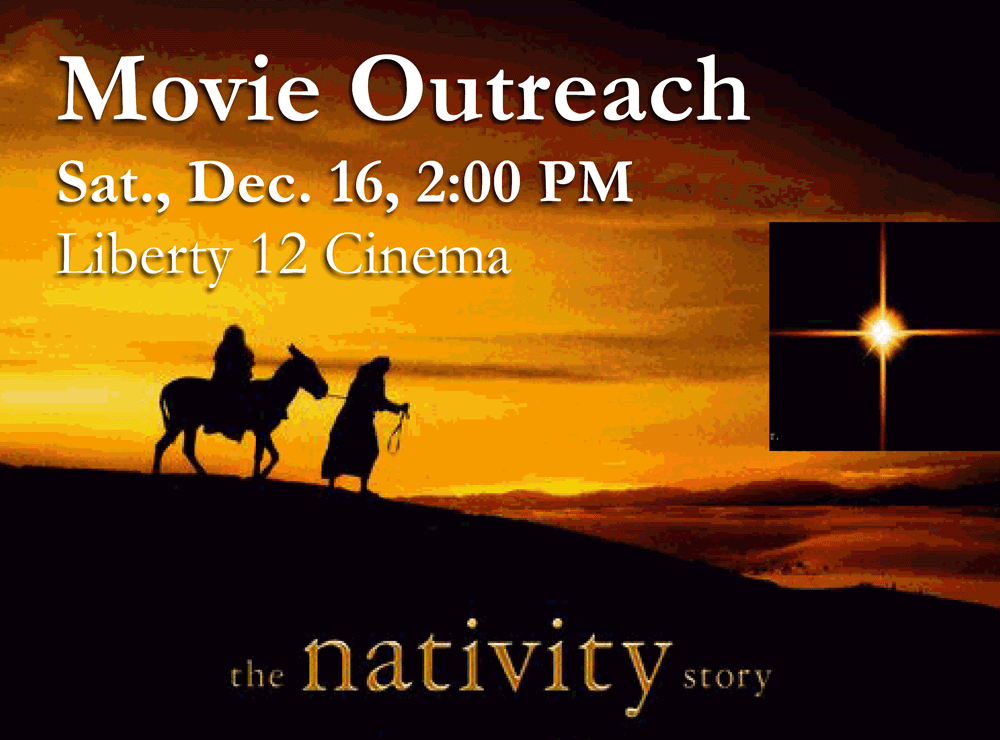
On Dec. 16, at 2:00 PM at the Liberty 12 Cinema, we were rent out a movie and go see "The Nativity Story" for an outreach event. Last year we did this with the Narnia film, and we had 100 members and 80 visitors go. Several came to worship with us that next Sunday, and some are still with us today. Praise God!

This ia a great opportunity to come and invite a friend. Tickets are $6 for members and $2 for guests. Let us know how many tickets you want.
This outreach will include a three week follow-up preaching series on Christ's birth. Interestingly, this series will actually meld will into the Exiles preaching series we have been doing.
Fox News had a recent headline that said: "Chicago Christmas Festival Nixes 'Nativity Story' Ads Over Fears of Offending Non-Christians" Part of the story is below.

CHICAGO — A public Christmas festival is no place for the Christmas story, the city says. Officials have asked organizers of a downtown Christmas festival, the German Christkindlmarket, to reconsider using a movie studio as a sponsor because it is worried ads for its film "The Nativity Story" might offend non-Christians.

New Line Cinema, which said it was dropped, had planned to play a loop of the new film on televisions at the event. The decision had both the studio and a prominent Christian group shaking their heads. Read the full story at http://www.foxnews.com/story/0,2933,232239,00.html.
---------------------------------------
Unbelievable, huh? The Christ story is offensive to America. Just another piece of evidence that we are a people "living in exile." What do you think this ban says about our nation?

Tuesday, November 21, 2006

We have much to be thankful for in Christ


Well, it is about Thanksgiving time. Normally, it would be our turn to go to Becki's mother's for Thanksgiving, but she just moved to Colorado. So we are going to two friends' houses for Thanksgiving, and then getting together with some neighbors on Friday. Two Thanksgiving meals--I know, it is quite a sacrifice!

Thanksgiving is always a good time to reflect on how blessed we are. Very, very few people in the world have a car, something we take for granted. Or even food--we struggle with too much food. Or clothing--we feel generous when we give away our "extra" clothing each year. Or religious freedom. Or an intact, loving family.

We are most blessed, however, because of Christ. Let us not forget him!

Pass the sweet potatoes, please . . .

Thursday, November 16, 2006

OJ Simpson's "Confession"--Should he find forgiveness?


O.J. Simpson has written a book explaining how if he had killed Nicole Brown Simpson, this is how he did it. There is also an upcoming television interview of Simpson on this.

Can you imagine Simpson's children reading a book in which their father describes in detail how he killed their mother? Either Simpson is a totally insane, sick individual, or he is so wracked with guilt, that he is finding a way to confess. That he got a $3 million book deal out of this seems to point towards the former.

But as twisted as this is, commentators have been calling Simpson "sub-human" or less than human. His actions are abhorrent, but he is still made in the image of God. And that means that he does have value and worth in God's eyes. And forgiveness can be found even for people Simpson. That is the hard to believe truth of the gospel.

What do you think about Simpson and forgiveness?

Thursday, November 09, 2006

The Fall of Evangelical Leader Ted Haggard

Ted Haggard, the president of a huge evangelical association and the pastor of a 14,000 member church, resigned last week amid allegations of sexual misconduct. This has led to the already rising chorus of thsoe who reject Chrisitians as hypocrites. On a side note, it turns out that Haggard also had written a diet book, and some interesting "reviews" have shown up on amazon. You have to check these "reviews" out. See http://www.amazon.com/gp/product/customer-reviews/1400072204/ref=cm_cr_dp_2_1/002-5363646-6420856?ie=UTF8&customer-reviews.sort%5Fby=-SubmissionDate&n=283155

Dr. Archibald Hart at Fuller has some insights into why so many high profile figures, both religious leaders and CEO types, are involved in radical acts of immorality. The adrenaline high and stress that is caused from these positions is numbing and addictive, causing normal pleasure to have no effect. It takes more and more stimulus for the brain to feel any pleasure, and only this risky behavior qualifies. This is not an excuse, but an explanation. I’m sure that these are good men and women who did not go into ministry intending to be duplicitous.

For me, this is yet another reason to move away from the idolization of megachurches. These churches do great good, but the pressure is simply too high for most of us mortal leaders to handle. The more we are lauded, the greater the pressure, and the more likely we will act out. Satan is at work too, and loves scandals like these. We should pray for Ted Haggard and his family.

Monday, November 06, 2006

How do you create close friendships?

Americans are starving for close friendships. This is particularly true with men, as 90% of American males say that they have no close friends. So in churches, the concept of "community"--which is a biblical concept--has a great ring to it. We hunger for community.

But how do we create these close feelings and close friends? Friendships come through shared experiences. And for men, close friendships are usually developed through doing things together. Witness the number of men who show up at a church "work day." Men need a mission, and when they do things together, they draw closer together. C.S. Lewis said that men bond better by doing things side by side, rather than face to face.

This has great implications for how we do life groups. Many churches have life groups that meet and try to create close friendships by "sharing." There is a definitely a place for this, but a constant dose of this is off-putting for many introverts and many men. By serving together, doing community projects and the like, many will draw together in ways that are even more memorable. You can view this distinction as the difference between a family meeting time and a family vacation. The latter will usually draw a family together more.

What are some experiences that have drawn you closer to others? Road trips? Short term missions? Vacations together? Other?

New missional book by Alan Hirsch - The Forgotten Ways


I would like to recommend an excellent forthcoming book by Alan Hirsch, author of The Shaping of Things to Come. Alan's new book, The Forgoteen Ways, will be available in January 2007. It is available for pre-order at amazon -http://www.amazon.com/Forgotten-Ways-Reactivating-Missional-Church/dp/1587431645/sr=8-1/qid=1162842844/ref=pd_bbs_sr_1/002-0811016-6015263?ie=UTF8&s=books

I took a D.Min. class under Alan at Fuller this fall, and much of the class' material was taken from this book. I can testify that this work is outstanding. Alan looks at the explosive growth in the early church and the church in China and concludes that this growth potential is inherent amongst God's people for all time. He also gives a practical framework for how this growth might be re-activated in churches today. I will give a fuller analysis and summary of this book in a later post.

Check out Alan's new blog and website at www.theforgottenways.org. More later. James