- Homemain page
- Aboutthe author
- Contact ussay hello
- Subscribe to RSSkeep updated!
Wednesday, May 23, 2007
The Limited Power of Preaching: Can you remember last week's sermon?
"We know that within two hours after leaving a church service, the typical individual cannot recall the theme of the sermon they heard. But if they have a discussion about a principle and its application to their life, or if they have a multi-sensory experience with those principles, they retain the information much longer and the probability that they will act on that information rises dramatically."
http://www.barna.org/FlexPage.aspx?Page=BarnaUpdate&BarnaUpdateID=194
Note that I did not say that preaching was a waste of time or that it did not have power or that it ought to be done away with. It does have power, and Paul confirmed this, stating that God had chosen the foolishness of preaching.
However, preaching ought to be one of several ways that we communicate truth in the assembly. Video, discussion, sharing of stories, art, and multiple voices help in communication and understanding the biblical message. And preaching itself ought to be more interactive. Alas, our physical arrangement and expectations of what constitutes an assembly limits us.
How do you suggest making the worship assembly more interactive and multi-sensory?
I'll Be Helping with OC's Lectures (Quest) May 31-June 2
It is great to see OC putting missional church on the schedule. Many movements begin in our Christian colleges, and I am happy to help with this in any way that I can.
Tuesday, May 22, 2007
The Celtic Way of Evangelism

You would think that the church in England, which had commissioned Patrick to go to Ireland, would be thrilled at this. However, they were not. They saw the role of a bishop as only having to do with two things: administration and chaplain duties. In other words, caring for faithful Christians. They were offended and angered that Patrick was spending the majority of his time with "pagans," "sinners," and "barbarians."
Sad, isn't it? But is that not the attitude of most churches today? Ministers should be the chaplains of the church, giving a peppy sermon on Sunday and spending the week hanging out with Christians, visiting hospitals, and the like. In other words, pastoral care and an internal focus. It is not that these things are bad, but that they are the overwhelming focus.
What if ministers acoss the nation spent the majority of their time with non-Christians--Wednesday night service at a local school function, Sunday night neighborhood fellowship groups, and the like. Which would reach more people for Christ? For that matter, what if the whole church--which is made up of ministers--did the same thing? We learn a powerful lesson from Patrick on how to reach the world today. We must go out, live incarnationally, and bless others' lives. And we need ministers who will take the lead in doing this.
What do you think most people's expectations for a minister is?
Monday, May 21, 2007
John and Ric shared a powerful story in our worship gathering
On Sunday during our worship gathering, John and Ric shared a powerful story of how they became friends and the value of friendship. Through this sharing, mulitple voices were heard, making this more of a communal event.Younger generations are moving towards a worship gathering that is more participatory, and less of a spectator event. This is a challenge in larger churches, but can be done through video, through multiple speakers, and by having a worship space that allows for phyiscal interation (tables, empty spaces, and the like).
For a look at some of these concepts, check out Dan Kimball's Emerging Worship.
http://www.amazon.com/Emerging-Worship-Creating-Gatherings-Generations/dp/0310256445/ref=pd_bbs_sr_1/102-5518143-5243312?ie=UTF8&s=books&qid=1179766134&sr=8-1
There are elements of emerging worship that are very good and biblical. 1 Cor. 14:26 says,
"What then shall we say, brothers? When you come together, everyone has a hymn, or a word of instruction, a revelation, a tongue or an interpretation. All of these must be done for the strengthening of the church." Preachers like Timothy still had a central preaching role, but clearly many people were involved in the assembly. Recovering this practice not only is biblical, but it can really help younger people connect as they hear many different people's stories. Remember, truth is intensely personal today.
There are some elements of emerging worship that are being done without much theological reflection. Theological reflection needs to occur on worship issues, otherwise emerging worship can become the new pragmatism--doing whatever works. As with all things, we should take the good and leave the bad.
What do you think of hearing more stories and more people participating in worship gatherings? Does hearing stories of people like Ric and John help your faith and worship experience?
New Book for Our Starbucks Group--Velvet Elvis

Bell combines a postmodern style with some deep and interesting biblical gems. He has done a lot of study on Judaism, which gives a lot of insight to some biblical texts on Jesus.
http://www.amazon.com/Velvet-Elvis-Repainting-Christian-Faith/dp/0310273080/ref=pd_bbs_sr_1/102-5518143-5243312?ie=UTF8&s=books&qid=1179759480&sr=8-1
Our Starbucks group continues to be a great gathering place for young adults, who love the atmosphere, the music, and the interactive setting. I also see in Starbucks some Boomers. People my age, Gen Xers, like Starbucks, but often have young kids and aren't able to go hang out a lot, though they enjoy it when they do. It is a good "third place."
Friday, May 18, 2007
A good friend of mine is coming in town today
I owe a lot to Chuck. He took me down to the jail to do Bible studies with inmates when I was a college student. This raised up in me a love for sharing my faith and leading others to Christ. I dropped out of medical school, and decided to go into ministry. The Wilshire congregation hired me full-time, and Chuck and I worked together for about four years.
This impressed upon me the importance of befriending, encouraging, and mentoring those around us. If you have a younger person in your life, seek to call them alongside you and help them grow in the Christian walk. You will enjoy this, and it will have a powerful affect on his or her life.
Thursday, May 17, 2007
Better Together: Restoring the American Community

I just started reading "Better Together: Restoring the American Community." http://www.amazon.com/Better-Together-Restoring-American-Community/dp/0743235460
It is written by Robert Putnam, author of Bowling Alone. I can tell you already it looks to be a great book. Putnam opens up the book talking about a group named Valley Interfaith, which worked with the community to improve the local schools. 86% of the students were economically disadvangeted, and 58% had limited proficiency in English.
Note these significant actions by Valley Interfaith:
1) Putnam states that "the teachers did not ask parents to come in to the school, but made visits to students' homes, asking parents about theirt hopes and worries regarding the school and their children. For many parents, it was the first real connection with the school, the first time anyone had bothered to ask their opinion." p.11
2) The workers in Valley Interfaith seek out community leaders whom they can train in leading ministries that help their community. Reformer Saul Alinsky believed that "reform could best be achieved when the citizens of poor and neglected communities organized and exertted power on their own behalf." Their motto is, never do anything for anybody that they can do for themselves. p.12
3) Their ministries were based around local support and ideas. "Unlike activist organizations that develop a public agenda first and then try to attract people who support it, the IAF encourages the emergence of local agendas from these congregations." p.12
4) Assessing community needs was done through "hundreds of one-on-one conversations."
It seems to me that this is a missional approach to serving the community--going to where people are, finding their needs, listening to them, and helping them be a part of improving their community.
These one-on-one interviews sort of reminds me of what Rick Warren did, but with a missional emphasis.
What if we took this approach to helping our community?
Books that I have read in the last year
I was recently asked what books I have read in the past year. I thought about this, going through my books, and I came up with the following list. It mainly covers missional church, postmodernism and culture, and evangelism.
It came to 41 books, nearly a book a week. That was a little higher than I thought it would be, but I do like to keep up with what is most current. On the other hand, my wife reminds me that my pleasure reading has taken a big dip, and she is right.
Anyway, here is the list. I'll try to go back and add links later. I have highlighted the top five I enjoyed for various reasons. If you have a question about one, let me know. I also have book reviews of many of these on my website, www.storyofredemption.com
- God's Missionary People: Rethinking the Purpose of the Local Church by Charles Van Engan
- Transforming Mission: Paradigm Shifts in Theology of Mission by David Bosch
- Organic Church: Growing Faith Where Life Happens by Neil Cole
- The Missional Leader: Equipping Your Church to Reach a Changing World by Alan Roxburgh, Fred Romanuck, and Eddie Gibbs
- The Present-Future by Reggie McNeal
- The Spontaneous Expansion of the Church: And the Causes Which Hinder It by Roland Allen
- Liquid Church by Pete Ward
- The Forgotten Ways by Alan Hirsch
- Off-Road Disciplines: Spiritual Adventures of Missional Leaders by Earl Creps
- Exiles: Living Missionally in a Post-Christian Culture by Michael Frost
- The Way of Jesus: A Journey of Freedom for Pilgrims and Wanderers by Jonathon S. Campbell with Jennifer Campbell
- Emerging Churches: Creating Authentic Community in a Postmodern Context by Eddie Gibbs and Ryan Bolger
- An Emergent Theology for Emerging Churches by Ray S. Anderson
- Post-Christendom: Church and Mission in a Strange New World
- Blue Like Jazz by Donald Miller
- Searching for God Knows What by Donald Miller
- A New Kind of Christian by Brian McLaren
- The Gospel According to Starbucks by Leonard Sweet
- Sprawl: A Compact History by Robert Bruegmann (on surbanization)
- The Blogging Church by Brian Bailey
- The Tipping Point by Malcom Gladwell
- Seeking a Lasting City: The Church’s Journey in the Story of God by Randy Harris, Richard Foster, and Mark Love
- Missional Church Planting by Ed Stetzer
- Simple Church: Returning to God’s Process for Making Disciples by Thom S. Rainer
- Breaking the Missional Code by Ed Stetzer
- Death by Suburb by David L. Goetz
- The Starfish and the Spider: The Unstoppable Power of Leaderless Organizations by Ori Brafman and Rod Beckstrom
- Confessions of a Reformission Rev.: Hard Lessons from an Emerging Missional Church by Mark Driscoll
- Everyday Theology: How to Read Cultural Texts and Interpret Trends edited by Kevin Vanhoozer
- The Big Idea: Focus the Message—Multiply the Impact by Dave Ferguson, Eric Bramlett, and Jon Ferguson
- Revolution by George Barna
- Biblical Preaching: The Development and Delivery of Expository Messages
- Preaching that Speaks to Women
- Christ-Centered Preaching: Redeeming the Expository Sermon
- Velvet Elvis: Repainting the Christian Faith by Rob Bell
- CrazyBusy: Overbooked, Overstretched, and About to Snap
- Culture Shift: Transforming Your Church from the Inside Out
- Why We Buy: The Science of Shopping by Paco Underhill
- Mission in the New Testament, edited by William J. Larkin Jr. and Joel F. Williams
- Exploring the Worship Spectrum: 6 Views Paul E. Engle, series editor
- Contextualization and Syncretism: Navigating Cultural Currents by Gailyn Van Rheenen
Wednesday, May 16, 2007
How big is your house?

The average size of a new home from approximately 1000 square feet at the end of World War II to nearly 2500 square feet by the end of the 20th century.[1] Meanwhile, the number of people per household has shrunk dramatically, from 3.14 persons per household in 1970 to 2.63 person per household in 1990.[2]
Isn't it ironic that our homes have exploded in size, while our families have decreased in number. We talk about needing to work longer today. But what we are actually working longer for is a perceived middle class lifestyle--which is vastly inflated from past years. If people 50 years ago saw most of our homes, they would think that we are all rich. And most us us are.
We are finishing out our basement--most of it ourselves--because it adds value to our home, is a big tax shelter for ministers, and can be used for fellowship. We are looking forward to this being done in the next month, and we believe we can really use this as a gathering place for both churched and unchurched Christians. But we can hardly make the argument that we "need" a bigger home.
What is up with the bigger houses today all across America? Hmm . . .
[1] Robert Bruegmann, Sprawl: A Compact History (Chicago: University of Chicago, 2005), 58.
[2] Ibid., 60.
Your Kids--Part of the Next Great Generation

I tell you, I am excited about the upcoming generation--the Millennials, or those born 1982 or later. Sure they do not know anything much about the Bible, but I believe that God is going to use them for something truly great.
Check out Millennials Rising, the next Great Generation by Neil Howe and William Strauss. http://www.amazon.com/Millennials-Rising-Next-Great-Generation/dp/0375707190/ref=pd_bbs_sr_1/102-5518143-5243312?ie=UTF8&s=books&qid=1179333663&sr=8-1
I am really amazed at this group of young people. They are polite, well-behaved, and well-adjusted. Unlike my generation, which grew up with parents constantly gone, they have had much parental involvement, a ton of coaching, and a lot of other adult involvement.
They also:
- Are racially diverse and accepting. They grew up with Tiger Woods and Halle Berry.
- They are team players.
- They are the most watched over generation in recent memory. They have had very little unsupervised time.
- They believe in the future and in themselves.
- They have high self-esteem.
- Well educated.
- High achievers.
- Techno wizards
- Look up to their parents
There are challenges with this generation, of course. But they are poised to truly be great. I sense an openness to authentic following of Jesus. And this is a good thing.
What positives do you see in Millennials?
Missional engagement in suburbia

Monday, May 14, 2007
My neighbor asked me to bless his house yesterday
Jesus may have been using house as in "household" and not a physical dwelling. But houses and households are usually quite inseparable, and usually the word translated "house" (oikos) has a double meaning.
I was thrilled to have this opportunity to bless my neighbor's house. I went over to his house, and we held hands with him, his wife, children, and extended family, and I prayed for them. I asked that God give them love, laughter, light, and blessing in all areas of their lives. I prayed for each room (living room, bedrooms, and kitchen), and I prayed that God might keep evil away from them.
It is great to know and be known by your community and your neighbors, and to have opporunities to serve those around us.
Viewing the church as story, rather than structure

Sunday, May 13, 2007
What I did for Mother's Day for my very special wife and very special mother
Thank you to all mothers out there. We fathers (and sons and daughters) would be a mess without you!
Friday, May 11, 2007
The Rise of the Millenial Generation--and unlike Boomers, they don't like to argue
My brother recently sent me a great article on the Millennial generation. http://www.bullnotbull.com/archive/fourth-turning-2.htmlInteresting that Newsweek's Boomer Fineman asserts that, "America was built on argument. Arguing is what we are." According to Strauss & Howe, it would be more appropriate for him to say "Arguing is what Boomers are."
US Divorce rate at lowest lewel since 1970, Cohabitation is up
The above news story on the US divorce rate is quite interesting. Some key points:
- The US divorce rate peaked in 1981 and is now at its lowest rate since 1970. That's not too from far from the time of the Beaver
- Families with two incomes and of higher education levels tend to have lower divorce rates
- Part of the decline is due to the increase in co-habitation and waiting longer to get married, so these numbers may be a bit deceiving.
Here is a good quote from the article on young adults and marriage/divorce.
"In the past 30 years, we've had more divorce than any culture has ever had," [Glenn Stanton, family policy expert] said. "A lot of young adults now are coming out of the family upheaval of the '70s, and they are cohabiting out of fear. They don't want to mess up the nice clean carpet of marriage - they saw their parents do that."
What implications does this have for ministry and outreach to young adults?
Is coffee unhealthy for you?
"Coffee is the drug of choice for the majority of North Americans." But is coffee unhealthy for you? According to Leonard Sweet, no. In his book, The Gospel According to Starbucks, http://www.amazon.com/Gospel-According-Starbucks-Living-Passion/dp/1578566495/ref=pd_bbs_sr_1/102-5326567-7226513?ie=UTF8&s=books&qid=1178894300&sr=8-1 Thursday, May 10, 2007
New Christians help us realize how blessed we are
New Christians bless our lives in so many ways. They have a gratitude and wonder that we long time Christians often do not have. I think of new Christians like Kim Smith, who inspire me every week as they talk in wonder about God and his blessings. My faith is built up through theirs. Thank you to all the new Christians who have taught me so much!
You won't believe these stats on time wasters
In his book Margin, Richard Swenson tells how in the 1960s people were testifying before Congress that in the future, one of the greatest challenges people would have would be filling all the extra time that they would have from the time-saving advances of technology.Yeah right. Technology actually takes time from us, because it speeds up the pace of life.
And note these stats. In a lifetime, the average American will:
- Spend six months sitting at trtaffic light waiting for them to change
- Spend one year searching through desk clutter looking for misplaced objects
- Spend eight months opening junk mail
- Spend two years trying to call people who aren't in or whose line is busy
- Spend five years waiting in lines
- Spend three years in meetings
This is a great book that talks about the dangers of leaving no "margin" in our finances, time, relationships, physical condition. It is a great book, written by a doctor.
Can you believe these stats?
Wednesday, May 09, 2007
Who do you want for a friend--Paula or Simon?

It struck me as the judges went around and commented on who they thought would go home that Paula had read that stat about needing 10 positives for every 1 negative. Paula just encouraged the contestants, while Simon said bluntly that he thought LaKisha was going home.
True, even I find Paula a bit sickly sweet at times. And it seems she often fails to say the obvious--that someone stunk it up. I guess it just goes to show how hard it is to hold back sometimes. We think that we have to always say the obvious. But we don't.
We all need a little Simon in our lives sometimes. But most of the time, we probably want someone to encourage us rather than kick us in the shins. It may look weak when we look at it from afar, but if we were on stage in front of millions of people, we probably wouldn't want someone to say we were horrible, ghastly, or the like.
Who would you want as a friend--Paula or Simon?
What is the relationship between physical health and spiritual health?

Could busyness be an attempt to avoid looking into the abyss?

Tuesday, May 08, 2007
Reconnecting with friends through technology
I know that myspace has gotten a lot of bad publicity. But I am glad to have technology like this that allows us to keep track of our friends all over the country. True, it is not a subtitute for living in community, but it does help one feel connected with a wider circle of friends. Before myspace, I would have had to wait until my 20 year reunion to find old friends.
People my age use sites like myspace mainly to reconnect, while younger people use it for much more. What online social networking group do you use, and how do you use it?
James
Add James' Blog to your Yahoo News Feed
There is now an +My Yahoo icon on this blog (see to the left under the blog name), so adding this is even easier. (see previous post)I keep learning new things on this from a book I got in yesterday, The Blogging Church by Brian Bailey. Part of the fifteen books that I got in from amazon. http://www.amazon.com/Blogging-Church-Brian-Bailey/dp/0787984876/ref=pd_bbs_sr_1/002-0811016-6015263?ie=UTF8&s=books&qid=1178631492&sr=8-1
Thanks for your patience!
Monday, May 07, 2007
Cool Church Website
If you go to the community section on their website, you will find one of the most innovative church sections around. It works a lot like myspace, allowing one to add photos, subscibe to blogs, post comments, and more.
Would you like to see these features in the church's website, and would you use them?
Friday, April 20, 2007
The gospel and outsourcing to India

Thursday, April 12, 2007
The Don Imus Firing--Lack of Redemption or Justice?
In case you have lived in a cave the past two weeks, Don Imus called the Rutgers women's basketball team a bunch of "nappy-headed ho's." After receiving a two-week suspension from CBS Radio and MSNBC, both programs fired Imus this week. Was this justice, or should Imus, who repeatedly apologized, have been given a second chance?
The question I had for myself was, if I leaned towards a second chance, was it because of my Christian background and belief in forgiveness and redemption? Or was it because I was a white male and didn't feel the true reprehensible nature of his words because of my "power" status in society? This was a real question that I debated in my own mind.
Imus' remarks were racist and derogatory towards all women. Imus has always said rude and cruel things, but usually they were directed towards those in power who were much better equipped to handle such things. This time he picked on the powerless--18-22 year old kids who should have been celebrating a great achievement, but instead find themselves belittled and made fun of for their race, gender, and physical appearance. There is nothing worse than a bully, which Imus proved to be on this occasion.
Imus was, I believe, fired for several reasons. First, the press conference that the Rutgers women's coach and team put on made Imus look incredibly small. The coach was incredibly well-spoken. Many of the members were outstanding in different ways--pretty, intelligent, talented. To their credit, they held back calling for his job and were willing to meet him. This only exposed Imus' own smallness.
Second, corporate sponsors began to flee the show. Talk radio is about making money, even if freedom of speech is allowed. But there was a sense from hearing the NBC News president speak that this was more than about money. The fact that corporations and network news executives will no longer put up with this kind of speech is telling how much America has changed in the last 50 years. Fifty years ago, racist and offensive sexist language was rampant at many levels of corporate America.
But the thing that seemed to really cause Imus to lose his job was his lack of support amongst his NBC colleagues. It was clear that he had few friends and few defenders. He simply had been cruel to too many people. There were reports that he used much racist language in private, making his apology ring hollow for many. This goes to show us that if we want people to support us during difficult times, we must build up a resovoiur of support.
I am a Christian, and I believe in forgiveness and redemption. I believe that Imus was sincere in his apology, and perhaps for the first time, wanted to change. He is a seemingly complex man, who has done much good with charity work. If we were in his shoes, would we not want a second chance too?
Truth be told, I cannot sort out my Christian background and superior, white male position enough to know which is influencing me. At the beginning of the week, I thought that he should be given a second chance based upon his seemingly sincere apology and willingness to make restitution. However, by the end of the week I became much more sympathetic to the position that he should be fired. For me, the tide turned when I heard about his pattern of racist remarks in private. It is one thing to make an on air mistake, even a large one. It is another to have a life time pattern of cruelty, both on and off the air. Tucker Carlson said that Imus was one of the most unpleasant men that he had ever known.
Imus tried to have it both ways--claiming to have an entertainment show and "shock jock" status, but then having senators and presidential candidates on his show with serious political discourse. As an American I defend his right to freedom of speech, but no one in position of power ought to use that power for cruelty to get a laugh, particularly against the powerless.
If Imus decides to put on a different show, and he can find a willing on-air partner, he should be given a second chance. Doesn't God do so with us? Justice was probably done here, but we should not be so quick to call for justice for others. As Jesus said, whatever measure we use to judge others will be used to judge us. I am saddened at his firing, even if deserved. I pray I never find myself in the same position. And if I do, I hope that I have built up enough of a resovoir of good will that others will say, no this is not who James is. He made a mistake, but we know his heart. Isn't that what you would want too?
Please let me know your thoughts. This is an important discussion.
Wednesday, April 04, 2007
Poll Resutls: Who do Americans think is going to heaven?
Perhaps even more interesting is that more people thought that Bill Clinton was going to heaven (52%) than Pat Robertson (47%).
Source: SoulTsunami by Leonard Sweet
What do you make of these interesting numbers?
Thursday, March 29, 2007
Some Conversation Tips for Sharing Our Faith

Will McRaney Jr., in his book The Art of Personal Evangelism, gives some great conversation tips when we are trying to share our faith with non-Christians.
These tips are:
- Use common language, not religious terms
- Avoid being argumentative
- Listen without interruption when the other person is talking
- Recognize that no means no, at least for the time being
- Respect the time and schedule of others
- Try to maintain goodwill so that you canengage in future conversations
- Avoid talking down other religious groups or individuals
- Remember that people have intellectual limits, so do not overwhelm them with too many Scriptures
- Try to leave with a win/win approach, not create winner and loser
- Remember that many people are not avid readers so other forms of material will be needed--videos, DVDs, CDs, etc.
In the past, people would debate various points of faith. Today, however, debate and argumentation are death for reaching people. People are tired of religious fighting over head matters with little care for the poor, world hunger, or many other things Jesus concerned himself with.
Instead of argument and debate, we must ask questions, actually listen to the answers, share our own experience, and invite others to join us in this experience.
What do you think of these conversations tips?
Wednesday, March 21, 2007
Liberty's Evangelistic Growth--Are We Satisfied?
We have recalcuated our church growth statistics at Liberty (see below).

Raw Growth for 2002-2007 (thru 3/14/07)
13% Biological Growth
45% Transfer Growth
42% Evangelistic Growth
Net Growth for 2002-2007 (thru 3/14/07)
20% Biological Growth
30% Transfer Growth
50% Evangelistic Growth
For fuller results. see:
http://www.libertychurchofchrist.org/yourti105973.html
The good news is that our recent baptisms and families that have been converted has pushed our percentage of evangelistic growth back above 42%. This is far above the norm. The bad news is twofold: 1) taking a kingdom perspective, sadly, most churches are not growing at all evangelistically; and 2) this growth rate does not come close to approximating the growth of the early church.
It is estimated that the early church grew at a rate of 40% per decade in the first three centuries--all evangelistic growth. As a movement, we have lost 20% in terms of our percentage of the US population over the last 26 years.
We have become so accustomed to our weak growth rate that we think that 20 baptisms in a year is very good. Indeed, we rejoice at those who accept Christ! But overall, we are failing to reach the lost in the United States.
How can we change this and regain the growth rate of the early church? What would have to happen for the church to grow 40% (evangelistically) this decade? What would it take for Liberty to do this?
Saturday, February 24, 2007
Harvard's new emphasis on applied knowledge is instructive for churches

Thursday, February 15, 2007
Tim Hardaway's Comments About Homosexuals
As Christians, we do believe that homosexuality is wrong. However, no Christian should hate homosexuals or anyone else. Incidents like this make hearing the Christian message difficult to hear.
For those in the church, we must take a stand against homosexuality. For those outside the church, however, God is the one who judges (1 Cor. 5). Homosexuals in the world should hear from Christians a message of love first and foremost, and then a call to accept Christ. This will entain leaving behind a homosexual lifestyle. Paul lists homosexuality as a sin, but then he says "such were some of you, but you have been washed, you have been cleansed." Christ's blood and the Spirit make this kind of transformation possible. We must call people to a different life, but we must also let them know that God will help them do this.
The message of hate must be eliminated and swallowed up by the incredible love of God.
What do you think of Hardaway's comments?
Friday, February 09, 2007
US population explodes, church membership flat

Obviously, we are not setting the world on fire. Not only are we not experiencing the explosive growth found in the book of Acts, but we are shrinking. Does this not show that we must reallocate our energy, time, and resources to mission and make this our primary focus, as it should be anyway? What we are doing is not working. We must face this square in the face.
Thursday, February 01, 2007
American Idol--thumbs up or thumbs down?

Becki has started recording the American Idol sessions, and I have been watching it really for the first time. Seriously, before this season, I had watched maybe ten minutes of American Idol. I love music, and so I probably would have been draw to the show except for two facts: 1) I have a hard time watching TV at 7:00 PM; and 2) I suppose I at times want to just go against whatever everyone else is doing.
It is actually a pretty entertaining show I have discovered this year. Some of the singers are really good. (I was going to rush to Memphis and try out until I learned that you had to be 28 years old.) But most of the singers they show in the early rounds are truly horrific. I find myself thinking, you cannot be serious about this.
Simon is, of course, the draw of the show. He is usually a jerk, which makes the times that he likes someone very dramatic. We all sigh a sign of relief when he gives the thumbs up.
It is amazing to me how some of the contestants put their whole lives and self-esteem into the collected wisdom of three entertainment people. These guys aren't always right. And however the world looks at us, they aren't always right either. They may give us the thumbs down, but that doesn't really mean anything. Look at that girl who didn't win American Idol but when on to start in that singing movie (you Idol buffs know what I'm talking about).
Those who aren't serious I don't really feel sorry for. But I do feel badly for some pretty good people who get ripped to shreds, like that music teacher. And what does this show show about us? Are we looking for approval and self-esteem from others? Do we delight in seeing others ripped? I will keep watching, but I just wondered about these things. What do you guys think?
Wednesday, January 10, 2007
Young Adults want a lifestyle and authenticity, not religion
Our Starbucks group continues to grow, with people inviting their friends. Last Monday we had some great discussion. We talked about how Jesus was liked by the non-religious people but disliked by the religious people. The reason he was loved by non-religious people? Because he ate with, drank with them, sat with them, talked with them, loved them. He did not shout at them with a bullhorn from afar, telling them how messed up they were. While calling them to a different life, he did this in close proximity to them, as he ate and drank with them.
On Monday, one of the Starbucks workers, a lovely young woman, asked what the book we were reading was about. She indicated that she didn't have much use for "religion," but seemed interested in a lifestyle of loving and serving other people. Jesus didn't have much use for "religion"--a bunch of heartless rituals that had no impact upon one's life.
Worship of God is important. But we should not forget that we are called to serve God and others continually--it is a lifestyle. Without this daily worship, our Sunday worship will be seen for what it is--a bunch of words without any substance.
What do you guys think about "religion"?
Wednesday, December 13, 2006
Is a Christian Video Game a Good idea?
On the one hand, it is good to bring God into every aspect of our lives. For those who spend hours playing video games, it would be good to reminded of Christian things. However, killing non-Christians is not a Christian concept. I guess I would have to play the game myself to better understand it. What do you guys think?
By the way, there is a new format for this blogger program, so you will have to re-register your name under the google format (see where you post). It just takes a half a second. Thanks!
Wednesday, December 06, 2006
Recommended book--Death by Suburb: How to Keep the Suburbs from Killing Your Soul

I wanted to recommend a great book on Christian Spirituality--Death by Suburb by Dave L. Goetz. Have you ever:
- Found yourself feeling smug because your neighbor's 13 year old kid says, "Cool car" when you got your new SUV?
- Signed up to help with the youth, only when your kid hit the youth group and never before?
- Found yourself afraid to enter Dollar General?
- Stayed up all night to finish your 6th graders' science project, while he was in the other room playing Nintendo?
- Lived vicariously through your kids?
- Given your eight year old a $2000 birthday party?
- Shopped around for a church that had the best programs for your kids, rather than asking, what church needs me most?
If any of these hit you, you will want to read this book. It has had a big impact upon my wife Becki and I. I grew up in the suburbs and minister in a suburban church. The struggles of suburban Christians are superficiality, materialism, self-centeredness, shallow relationships, worship of children, and lack of service. Goetz writes in a funny, caustic style with brutal self-disclosure and honesty. You will love this book.
What struggles do you see in suburban Christians?
Here is the link to amazon for this book. http://www.amazon.com/Death-Suburb-Keep-Suburbs-Killing/dp/0060756705/sr=8-1/qid=1165471559/ref=pd_bbs_1/002-3852808-5347201?ie=UTF8&s=books
New sign-In for comments, with better features!
Thursday, November 30, 2006
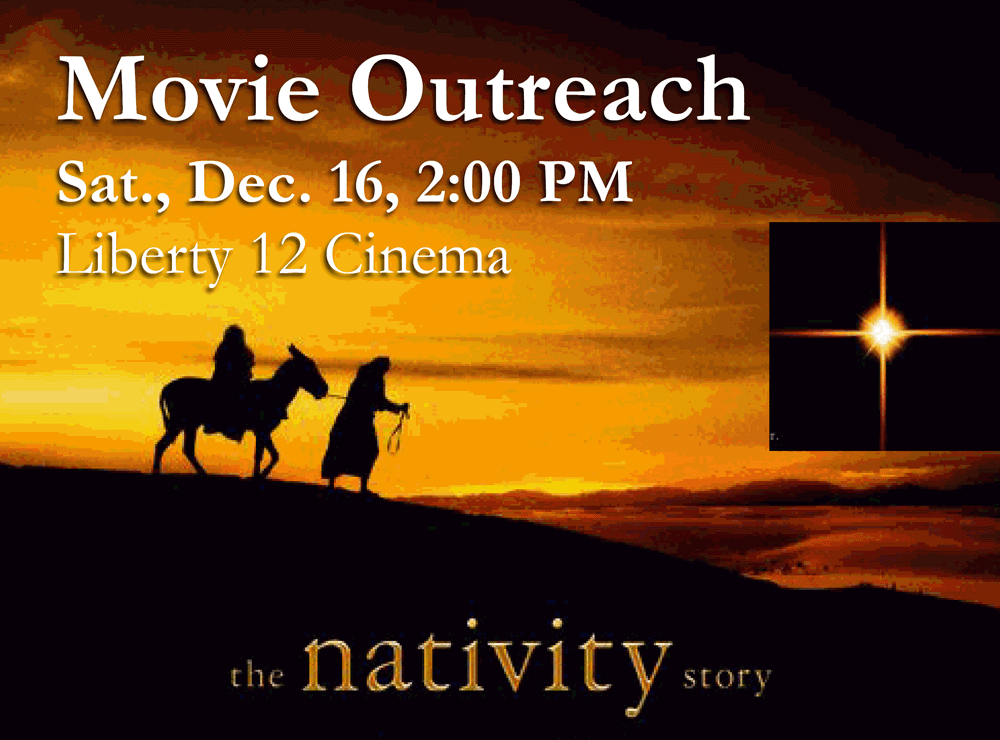
The Nativity Story is banned in Chicago
This ia a great opportunity to come and invite a friend. Tickets are $6 for members and $2 for guests. Let us know how many tickets you want.
CHICAGO — A public Christmas festival is no place for the Christmas story, the city says. Officials have asked organizers of a downtown Christmas festival, the German Christkindlmarket, to reconsider using a movie studio as a sponsor because it is worried ads for its film "The Nativity Story" might offend non-Christians.
New Line Cinema, which said it was dropped, had planned to play a loop of the new film on televisions at the event. The decision had both the studio and a prominent Christian group shaking their heads. Read the full story at http://www.foxnews.com/story/0,2933,232239,00.html.
Tuesday, November 21, 2006
We have much to be thankful for in Christ
Well, it is about Thanksgiving time. Normally, it would be our turn to go to Becki's mother's for Thanksgiving, but she just moved to Colorado. So we are going to two friends' houses for Thanksgiving, and then getting together with some neighbors on Friday. Two Thanksgiving meals--I know, it is quite a sacrifice!
Thanksgiving is always a good time to reflect on how blessed we are. Very, very few people in the world have a car, something we take for granted. Or even food--we struggle with too much food. Or clothing--we feel generous when we give away our "extra" clothing each year. Or religious freedom. Or an intact, loving family.
We are most blessed, however, because of Christ. Let us not forget him!
Pass the sweet potatoes, please . . .
Thursday, November 16, 2006
OJ Simpson's "Confession"--Should he find forgiveness?

O.J. Simpson has written a book explaining how if he had killed Nicole Brown Simpson, this is how he did it. There is also an upcoming television interview of Simpson on this.
Can you imagine Simpson's children reading a book in which their father describes in detail how he killed their mother? Either Simpson is a totally insane, sick individual, or he is so wracked with guilt, that he is finding a way to confess. That he got a $3 million book deal out of this seems to point towards the former.
But as twisted as this is, commentators have been calling Simpson "sub-human" or less than human. His actions are abhorrent, but he is still made in the image of God. And that means that he does have value and worth in God's eyes. And forgiveness can be found even for people Simpson. That is the hard to believe truth of the gospel.
What do you think about Simpson and forgiveness?
Thursday, November 09, 2006
The Fall of Evangelical Leader Ted Haggard

Dr. Archibald Hart at Fuller has some insights into why so many high profile figures, both religious leaders and CEO types, are involved in radical acts of immorality. The adrenaline high and stress that is caused from these positions is numbing and addictive, causing normal pleasure to have no effect. It takes more and more stimulus for the brain to feel any pleasure, and only this risky behavior qualifies. This is not an excuse, but an explanation. I’m sure that these are good men and women who did not go into ministry intending to be duplicitous.
For me, this is yet another reason to move away from the idolization of megachurches. These churches do great good, but the pressure is simply too high for most of us mortal leaders to handle. The more we are lauded, the greater the pressure, and the more likely we will act out. Satan is at work too, and loves scandals like these. We should pray for Ted Haggard and his family.
Monday, November 06, 2006
How do you create close friendships?
But how do we create these close feelings and close friends? Friendships come through shared experiences. And for men, close friendships are usually developed through doing things together. Witness the number of men who show up at a church "work day." Men need a mission, and when they do things together, they draw closer together. C.S. Lewis said that men bond better by doing things side by side, rather than face to face.
This has great implications for how we do life groups. Many churches have life groups that meet and try to create close friendships by "sharing." There is a definitely a place for this, but a constant dose of this is off-putting for many introverts and many men. By serving together, doing community projects and the like, many will draw together in ways that are even more memorable. You can view this distinction as the difference between a family meeting time and a family vacation. The latter will usually draw a family together more.
What are some experiences that have drawn you closer to others? Road trips? Short term missions? Vacations together? Other?
New missional book by Alan Hirsch - The Forgotten Ways

I would like to recommend an excellent forthcoming book by Alan Hirsch, author of The Shaping of Things to Come. Alan's new book, The Forgoteen Ways, will be available in January 2007. It is available for pre-order at amazon -http://www.amazon.com/Forgotten-Ways-Reactivating-Missional-Church/dp/1587431645/sr=8-1/qid=1162842844/ref=pd_bbs_sr_1/002-0811016-6015263?ie=UTF8&s=books
I took a D.Min. class under Alan at Fuller this fall, and much of the class' material was taken from this book. I can testify that this work is outstanding. Alan looks at the explosive growth in the early church and the church in China and concludes that this growth potential is inherent amongst God's people for all time. He also gives a practical framework for how this growth might be re-activated in churches today. I will give a fuller analysis and summary of this book in a later post.
Check out Alan's new blog and website at www.theforgottenways.org. More later. James
Friday, October 27, 2006
Starbucks discussion group/book talk is off the "ground"
Just wanted to give you an update on the Starbucks discussion group/book talk. Last Monday we met for the first time. While there, a great young man was sitting next to us. Overhearing our discussion, he expressed his interest in our group and will probably join us next week.
I also happened to mention the discussion group/book talk to the local OC alumni group. One of the members said that she had been looking for something like this, and plans to join us. We hope to welcome them both.
Isn't God amazing? When we go out, as we are called to do, he starts to open doors. If you would like to join us, we will meet again at 7:00 PM at the Starbucks this Monday, Oct. 30. If you are going to Monday Night for the Master, you can eat a meal up at the building at 6:00 PM, and then go over with us after this. This is a great opportunity to invite a friend to a natural, non-threatening setting for some good drink and discussion.
Wednesday, October 18, 2006
Christianity is about a lifestyle, not one hour a week
Do you feel sometime that something is missing in our "Christian" lives? So many times we divide Sunday morning from the rest of the week. One hour a week is sacred, and the rest is secular. Is this how Jesus saw life? No, he saw his whole life as a mission of God.
Michael Frost has developed a set of missional practices for their community to help them live the Christian life 24/7. They join together with one or two other Christian friends and seek to do the following together:
B-Bless the lives of 3 people each week (1 a Christian, 1 a non-Christian, 1 either);
E-Eat together with 3 others each week (1 Cbristian, 1 a non-Christian, 1 either);
L-Learn about Jesus’ life style by reading a gospel or reading about Jesus each week;
L-Listen to God’s voice each week;
S-Send—spend time in a “third place” each week (café, coffeeshop, common interest group, etc.) to get to know non-Christians. Again, do this together with 1 or 2 Christian friends.
What kind of impact would this make upon the world and our own lives if we consistently adopted this lifestyle?
Monday, October 09, 2006
Discipleship comes through doing, not thinking
Here is a thought on discipleship. How did Jesus create disciples? He didn't have them sit around and study concepts. He said, "Come, follow me." We think that information and study leads to transformation. It rarely does. Think about how many sermons we have heard. Then think about how many times this actually changed our behavior. Ouch.
We need to disciple not by saying, study this. We need to disciple by saying, Come alongside me and serve. Then, as we are "on the road," teaching moments come up. This behavior leads to a change of thinking. The problem is that most of us have never actually been discipled.
What percentage of things that we hear do you think that we actually put into practice?
Thursday, September 28, 2006
The Dark Side of Technology

It might be ironic that you are reading about "the dark side of technology" on the web. And I am like most other guys, fascinated by tech gadgets. But I wonder sometimes about how technology is affecting us. Some negative effects:
1) We are constantly on call.
With email and cell phones, work is always with us. This lack of boundaries is dangerous. We all need mental rest from work.
2) We take shortcuts in relationships.
Email is great for information and easy chatting. However, it stinks for intimacy or heated discussion. If 85% of communication is non-verbal, email leaves way too much room for misunderstanding. And there is a temptation to send an email--get out what we want to say--and not have to face the person with whom we are corresponding.
3) Time. TV watching per person per day is over 4 hours for the average viewer in the US. This has actually gone up, even while web surfing is going up dramatically. This means that we are spending less and less physical time with one another.
What are good and poor uses of technology in relationships and ministry today?
Wednesday, September 20, 2006
Starbucks bucks trend and gives generous benefits to workers
Certainly companies are now offering much fewer benefits. Part of this is necessary to stay in business, but much of this seems driven by quarterly earnings reports and compensation at the top.
I usually have been "pro-growth" and the like, but shouldn't companies think about people as well as profits? As we talk about living missionally, how does this affect how Christians act in the workplace? Should we be driven by the bottom line or by people? What if this means risking our own job because we are not meeting numbers?
Tuesday, September 05, 2006
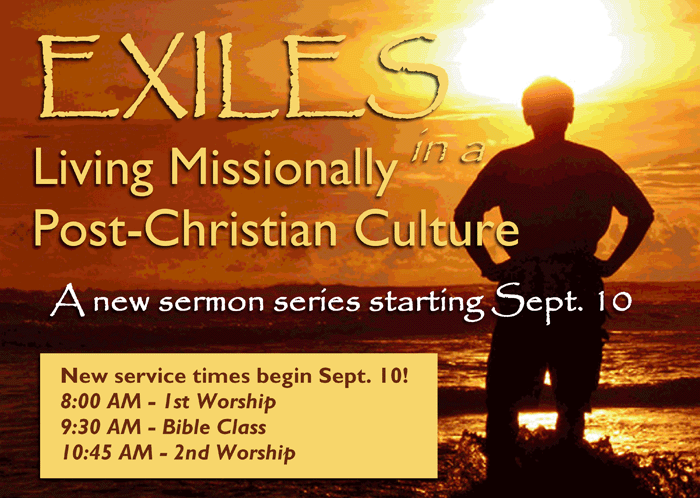
Exiles - Living Missionally in a Post-Christian Culture
Once Christians felt at home in the United States. Laws favored morality. Prayer was practiced in schools. Our civic leaders were expected to be Christian, and they always were. Churches were at the center of the town square, symbolizing their central place in society.Now, however, things have changed.
Laws are being overturned. Other faiths and moralities are not only tolerated, but promoted. Employers band Christian talk but celebrate alternative lifestyles. And many look everywhere but the church for Spirituality and are hostile towards Christians. We are in exile.
In an upcoming sermon series, I'll address these issues. I would love to hear from you on this. What challenges do you face as a Christian at work or at home? How can we best respond to these challenges?
Wednesday, August 23, 2006
What will people say at your funeral?
It got me thinking--wouldn't it be great to have the kind of legacy that Jim has? Kind of makes you think about your life, doesn't it? In the end, the only thing people will remember fondly are, did you love God, and, did you love people?
Wednesday, August 16, 2006
Impulsive Shopping
One of those ways was putting escalators far apart so that you have to walk past more shops and items in order to get to the next escalator. In doing this, we will pass by items we didn't come to buy and buy them anyway.
Boy, we sure are easily manipulated! But we really shouldn't blame them--it is the materialism in us. Why do you think we are so impulsive in buying?
Wednesday, August 09, 2006
"Bully" video game brings up issue of violence and media

A news article today about a new video game coming out in October named "Bully" that is the subject of some controversy. At first, I thought perhaps that the player would be a bully, which would certainly promote bad behavior.
Instead, "the game's main character is 15-year-old Jimmy Hopkins, who must defend himself against school bullies at a fictional U.S. boarding school called Bullworth Academy, while dealing with characters ranging from nerds and jocks to authoritarian prefects."
I suppose that is not so bad, though this video game maker is also the maker of Grand Theft Auto--a violent and sexually graphic video game.
I grew up playing fantasy computer games, but they had no sexual content, were always good guys vs. bad guys, and were not so graphic in their violence. Do today's games cross the line? Do video games create violent tendencies in kids? What do you think?
Wednesday, August 02, 2006
How can we use technology in church (in and out of worship)?

An artcle just released by Reuters said that diamonds are no longer a girl's best friend,. According to a new U.S. study, three of four women would prefer a new plasma TV to a diamond necklace. The study also found that women were found on average to own 6.6 technology devices while men own 6.9--a virtual tie, and a surprising reversal.
When women are preferring tech gadgets to diamonds, we know that we have reached a paradigm shift in our culture. Technology is becoming ubiquitous.
Which brings up issue of the church and technology. While we now have powerpoint displays, we are still pretty low-tech in most all of our churches. How could we use things such as the web, text messaging, imagery, etc. more effectively both inside and outside of our worship? (Matt, any ideas?)
Tuesday, July 25, 2006
Comparing Ourselves to Others
I just read how Avery Johnson, the first-year head coach of the Dallas Mavericks is seeking reworking of his coaching contract. He is scheduled to make $2.5 MILLION dollars this year and the next two years. However, he took the Mavs to the NBA finals in only his first year as coach, and his coaching salary is in the bottom third of the league.
One sports writer said it well. This is not about money--$2.5 million is enough there--but about respect. And if someone else makes more, even if we are doing fine, and we feel that we are doing a better job, it bothers us. It's easy to pick on Avery, but we probably would feel the same thing in the same type of situation, right or wrong. Human nature.
Is it ever appropriate to compare ourselves to others?
Wednesday, July 12, 2006
Reason or Experience--How do we know truth?
The dismissal of experience in discovering truth comes from our Enlightenment & Restoration Heritage. Is this, however, correct? I would say no on three levels.
1. In our everyday lives, we come to belief and truth primarily through experience.
When I was dating my wife, I did not merely accept a reasonable proposition that she would make a good mate for me. I experienced her--her presence, her laugh, her holding of my hand. In teaching Gina (our 5 year old daughter) to pray, I didn't teach her a proposition about God. I taught her to say prayers, and through that process she came to accept God as Father.
2. Scripture places a high value on experience.
Note these words from John:
That which was from the beginning, which we have heard, which we have seen with our eyes, which we have looked at and our hands have touched—this we proclaim concerning the Word of life. 2 The life appeared; we have seen it and testify to it, and we proclaim to you the eternal life, which was with the Father and has appeared to us. 3 We proclaim to you what we have seen and heard, so that you also may have fellowship with us.
The earliest Christians believed in Christ not because it was merely "reasonable," but primarily because they experienced Christ.
3. People today especially value experience in coming to know truth. Part of this is because "reasonable" people have committed horrible atrocities (i.e., Nazis), and reason has not prevented continued wars, hate crimes, etc. Part of this is because we get so many advertizements that the only way to know if something really works is to try it--or to listen to someone else who has tried it.
So, in order to convince people of the truth of Christianity, we must be able to point towards our experience. What positive experiences can we share with others that demonstrate the truth of our faith?
Wednesday, July 05, 2006
Are we "Clicking" Our Lives Away?
On Monday night, Becki and I went with some friends to see a movie. We had intended to see "Superman Returns," but there was not a showing at the time we needed. So we went to see "Click" with Adam Sandler
While billed as a comedy--and the film did have some funny moments--it turns sharply serious in the second half. In the film, Sandler's character receives a universal remote that controls the universe. With it he can pause or fast forward life. He ends up fast forwarding all the unpleasant parts of his life (arguments, showering, drugery at work, etc.), and in so doing, realizes that he has missed life itself.
About a month ago I caught myself actually wanting to fast forward my life two weeks, I had so much to get done. What does this say about us? Are we just too busy, or do we simply not value life enough? Aren't bad times better than a life unlived?
New Church Plants
-
A Tale of Two Leaders8 years ago
Theology and Popular Culture Blogs/Websites
-
Dolly Parton: National Treasure2 months ago
-
-
-
-
-
Favorite Posts
- Churches in coffee shops and homes a growing trend
- Harvard's New Emphasis on Applied Knowledge is Instructive to Churches
- Young Adults want a lifestyle and authenticity, not religion
- My neighbor asked me to bless his house yesterday
- Exiles-Living Missionally in a Post-Christian Culture
- Christianity is about a lifestyle, not one hour a week
- Emotion in Worship
- Death by Suburb
- The Don Imus Firing--Lack of Redemption or Justice?
- Books That I Have Read in the Last Year
Some Other Blogs & Sites I frequent
About Me
- James Nored
- I currently am a preaching minister, evangelist, and missional leader at the High Pointe Church of Christ in McKinney, TX. I am working towards a Doctor of Ministry at Fuller Theological Seminary in Pasadena, CA, studying missional church, evangelism, and postmodern culture. I give missional church and Spiritual gifts seminars for churches. I have written an evangelistic Bible study for postmoderns (Story of Redemption), New Members class material, and a work on Spiritual gifts. I am blessed with a wonderful wife (Becki) of 13 years and two beautiful daughters (Gina-age 7, Emily-4), the loves of my life.