Thursday, September 28, 2006

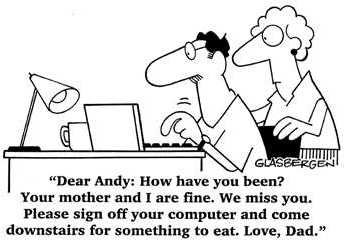
The Dark Side of Technology


It might be ironic that you are reading about "the dark side of technology" on the web. And I am like most other guys, fascinated by tech gadgets. But I wonder sometimes about how technology is affecting us. Some negative effects:

1) We are constantly on call.
With email and cell phones, work is always with us. This lack of boundaries is dangerous. We all need mental rest from work.

2) We take shortcuts in relationships.
Email is great for information and easy chatting. However, it stinks for intimacy or heated discussion. If 85% of communication is non-verbal, email leaves way too much room for misunderstanding. And there is a temptation to send an email--get out what we want to say--and not have to face the person with whom we are corresponding.

3) Time. TV watching per person per day is over 4 hours for the average viewer in the US. This has actually gone up, even while web surfing is going up dramatically. This means that we are spending less and less physical time with one another.

What are good and poor uses of technology in relationships and ministry today?

Wednesday, September 20, 2006

Starbucks bucks trend and gives generous benefits to workers

Last night on the "Big Idea with Donny Deutsch" (or whatever that guy's name is), the Chairman of Starbucks was on. He talked about how the company tried to really take care of their employees, offering full health benefits for part-time workers and stock buying. He said that he was shaped by the experience of his father being injured on the job and receiving no compensation.

Certainly companies are now offering much fewer benefits. Part of this is necessary to stay in business, but much of this seems driven by quarterly earnings reports and compensation at the top.

I usually have been "pro-growth" and the like, but shouldn't companies think about people as well as profits? As we talk about living missionally, how does this affect how Christians act in the workplace? Should we be driven by the bottom line or by people? What if this means risking our own job because we are not meeting numbers?

Tuesday, September 05, 2006

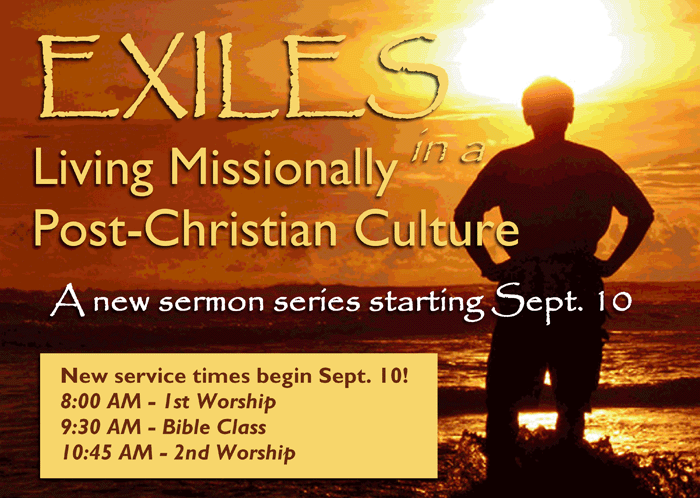
Exiles - Living Missionally in a Post-Christian Culture

Sorry for the posting delay! Blogger was apparently having problems last week. Upwards and onward!

Once Christians felt at home in the United States. Laws favored morality. Prayer was practiced in schools. Our civic leaders were expected to be Christian, and they always were. Churches were at the center of the town square, symbolizing their central place in society.Now, however, things have changed.

Laws are being overturned. Other faiths and moralities are not only tolerated, but promoted. Employers band Christian talk but celebrate alternative lifestyles. And many look everywhere but the church for Spirituality and are hostile towards Christians. We are in exile.

In an upcoming sermon series, I'll address these issues. I would love to hear from you on this. What challenges do you face as a Christian at work or at home? How can we best respond to these challenges?

Wednesday, August 23, 2006

What will people say at your funeral?

Last Monday night I went to Marysville to attend the funeral of Jim Wiggins. Jim was a long time member of the church and an incredible man. In fact, I have never been to a funeral where it was clear that someone was so universally loved--and I've been to a lot of funerals.

It got me thinking--wouldn't it be great to have the kind of legacy that Jim has? Kind of makes you think about your life, doesn't it? In the end, the only thing people will remember fondly are, did you love God, and, did you love people?

Wednesday, August 16, 2006

Impulsive Shopping

I read recently an online article named "5 Sneaky Mall Tricks." It detailed ways that shopping malls work to get us to spend more money than we originally planned.

One of those ways was putting escalators far apart so that you have to walk past more shops and items in order to get to the next escalator. In doing this, we will pass by items we didn't come to buy and buy them anyway.

Boy, we sure are easily manipulated! But we really shouldn't blame them--it is the materialism in us. Why do you think we are so impulsive in buying?

Wednesday, August 09, 2006

"Bully" video game brings up issue of violence and media

Sorry for the publishing delay--I've spent the last five days dealing with a nasty bug. Anyway.

A news article today about a new video game coming out in October named "Bully" that is the subject of some controversy. At first, I thought perhaps that the player would be a bully, which would certainly promote bad behavior.

Instead, "the game's main character is 15-year-old Jimmy Hopkins, who must defend himself against school bullies at a fictional U.S. boarding school called Bullworth Academy, while dealing with characters ranging from nerds and jocks to authoritarian prefects."

I suppose that is not so bad, though this video game maker is also the maker of Grand Theft Auto--a violent and sexually graphic video game.

I grew up playing fantasy computer games, but they had no sexual content, were always good guys vs. bad guys, and were not so graphic in their violence. Do today's games cross the line? Do video games create violent tendencies in kids? What do you think?

Wednesday, August 02, 2006

How can we use technology in church (in and out of worship)?


An artcle just released by Reuters said that diamonds are no longer a girl's best friend,. According to a new U.S. study, three of four women would prefer a new plasma TV to a diamond necklace. The study also found that women were found on average to own 6.6 technology devices while men own 6.9--a virtual tie, and a surprising reversal.

When women are preferring tech gadgets to diamonds, we know that we have reached a paradigm shift in our culture. Technology is becoming ubiquitous.

Which brings up issue of the church and technology. While we now have powerpoint displays, we are still pretty low-tech in most all of our churches. How could we use things such as the web, text messaging, imagery, etc. more effectively both inside and outside of our worship? (Matt, any ideas?)

Tuesday, July 25, 2006

Comparing Ourselves to Others

Hello, loyal readers. Sorry for the posting delay. Last week I was at the Biltmore Church of Christ in Asheville, North Carolina. I gave a "Missional Church" seminar there, which was very well received. Just so you know, I usually try to post a new thought by each Tuesday, with follow-up comments throughout the week.

I just read how Avery Johnson, the first-year head coach of the Dallas Mavericks is seeking reworking of his coaching contract. He is scheduled to make $2.5 MILLION dollars this year and the next two years. However, he took the Mavs to the NBA finals in only his first year as coach, and his coaching salary is in the bottom third of the league.

One sports writer said it well. This is not about money--$2.5 million is enough there--but about respect. And if someone else makes more, even if we are doing fine, and we feel that we are doing a better job, it bothers us. It's easy to pick on Avery, but we probably would feel the same thing in the same type of situation, right or wrong. Human nature.

Is it ever appropriate to compare ourselves to others?

Wednesday, July 12, 2006

Reason or Experience--How do we know truth?


The dismissal of experience in discovering truth comes from our Enlightenment & Restoration Heritage. Is this, however, correct? I would say no on three levels.

1. In our everyday lives, we come to belief and truth primarily through experience.
When I was dating my wife, I did not merely accept a reasonable proposition that she would make a good mate for me. I experienced her--her presence, her laugh, her holding of my hand. In teaching Gina (our 5 year old daughter) to pray, I didn't teach her a proposition about God. I taught her to say prayers, and through that process she came to accept God as Father.

2. Scripture places a high value on experience.
Note these words from John:
That which was from the beginning, which we have heard, which we have seen with our eyes, which we have looked at and our hands have touched—this we proclaim concerning the Word of life. 2 The life appeared; we have seen it and testify to it, and we proclaim to you the eternal life, which was with the Father and has appeared to us. 3 We proclaim to you what we have seen and heard, so that you also may have fellowship with us.

The earliest Christians believed in Christ not because it was merely "reasonable," but primarily because they experienced Christ.

3. People today especially value experience in coming to know truth. Part of this is because "reasonable" people have committed horrible atrocities (i.e., Nazis), and reason has not prevented continued wars, hate crimes, etc. Part of this is because we get so many advertizements that the only way to know if something really works is to try it--or to listen to someone else who has tried it.

So, in order to convince people of the truth of Christianity, we must be able to point towards our experience. What positive experiences can we share with others that demonstrate the truth of our faith?

Wednesday, July 05, 2006

Are we "Clicking" Our Lives Away?


On Monday night, Becki and I went with some friends to see a movie. We had intended to see "Superman Returns," but there was not a showing at the time we needed. So we went to see "Click" with Adam Sandler

While billed as a comedy--and the film did have some funny moments--it turns sharply serious in the second half. In the film, Sandler's character receives a universal remote that controls the universe. With it he can pause or fast forward life. He ends up fast forwarding all the unpleasant parts of his life (arguments, showering, drugery at work, etc.), and in so doing, realizes that he has missed life itself.

About a month ago I caught myself actually wanting to fast forward my life two weeks, I had so much to get done. What does this say about us? Are we just too busy, or do we simply not value life enough? Aren't bad times better than a life unlived?

Tuesday, June 27, 2006

Churches in coffee shops & homes a growing trend

A recent article in the Christian Chronicle highlights the growing trend of churches meeting in non-traditional locales. For the full article, see http://www.christianchronicle.org/modules.php?name=News&file=article&sid=342. The article states:

Prominent evangelical Christian researcher George Barna predicts that within 20 years, one-third of American church members will explore alternative forms of worship, such as home churches, workplace ministries or online faith communities. He suggests many Americans are leaving regular churches “precisely because they want more of God in their life but cannot get what they need from a local church.”“They have decided to get serious about their faith by piecing together a more robust faith experience,” Barna said last year. “Instead of going to church, they have chosen to be the church."

My thoughts--it seems that our normal, formal assemblies do not connect with younger generations. They miss the relational aspect of the church, and coffee shops and homes promote a relational atmosphere. The physicality of the worship assembly subconsciously communicates to us what is appropriate, and sitting in rows of pews communicates formality and an audience atmosphere. If we do not somehow address this, we risk losing the younger generations.

What do you think about coffee shop and house churches? And how can we make traditional church settings more relational?

Monday, June 19, 2006

Baptism-Saying "I Do"

Making the decision to trust God with our lives and become a follower of Jesus is hugely important. In the world we live in today, there are so many other options of whom to trust and follow.

There are the traditional siren calls of work, sex, money, and power, seeking to wreak havoc upon our lives and families. We live in a pluralistic world in which other religions are readily accessible. And then there is always the temptation to simply follow our own inner voice and compass, the advice given by “New Age” experts and self-help books. It is easy for our commitment to wane or disappear.

So how can we know that we have made the decision to follow Christ, particularly when we struggle with our commitment? The answer? Baptism.

Here, an analogy to marriage is helpful. Any two people who come together know that there are other fish in the sea. How do they know that each is committed to the other? Because there is a wedding ceremony, an exchange of rings, and an exchange of vows. And if the husband or wife wants to know if they have ever made a commitment to the other person, all he or she has to do is look at the wedding ring on his or her finger.

In the same way, baptism is our assurance that we have committed to Christ and that he has committed to us. Peter says, “. . . 21 and this water symbolizes baptism that now saves you also—not the removal of dirt from the body but the pledge of a good conscience toward God. It saves you by the resurrection of Jesus Christ” (1 Pet. 3:21).

What has your baptism meant to you? Do you remember it when you encounter difficulty? Have you viewed it as a commitment?

Wednesday, June 14, 2006

Gay Marriage Amendment-Part 2

With The Da Vinci Code, there has been a lot of talk about what the emperor Constantine did. I can tell you that, contrary to the book's claims, he did not collate the Bible (see my Sunday morning class). However, he did: legalize Christianity, give tax breaks to clergy, and make Sunday a day off. In short, he began the whole Christendom era, where Christians enjoy benefits from the government, such as favorable laws that support our faith and sense of morality.

Now, the Christendom era is being to disappear. And we don't like it. This is what is so upsetting about the gay marriage issue. We are not used to government being against us. I suppose I somewhat buy the idea that the courts are bucking the will of the people, and that an amendment is needed to ensure that this does not happen.

However, I am disturbed that this seems to be Christians' only response. Jesus did not pass a single law. He did not lobby a senator. He didn't try to change the Roman constitution, as if they had any. And he didn't give his disciples instructions to do so either (though I don't think it is wrong to vote). Instead, he sent his disciples out into the world to be salt and light. To change people's hearts through love and service. The problem isn't that there is a law allowing gay marriage, but that people want this type of lifestyle. This will never be changed through a law, but only through seeing Christ in us.

What do you think the primary response to gay marriage should be?

Tuesday, June 06, 2006

Gay Marriage Amendment-Part 1


The Republicans are beating the drum of a constitutional amendment to ban gay marriage, defining marriage as being between a man and a woman. This is an issue that they dropped like a hot potato after the 2004 election, but now suspiciously is being taken back up 5 months before the 2006 elections and when President Bush's approval rating is at 30%. I'll leave the sincerity of these events to other bloggers. However, I do want to take up the issue of law and morality.

At one time, adultery was against the law. Also banned--all kinds of bedroom issues between married couples that today we would consider normal behavior. No one, however, is clamoring to go back to these times. I, of course, am not for gay marriage. I just wonder why we pick and choose our moral issues that we want encoded in law. I suspect that we want outlawed things which we know are not temptations for us, but do not want outlawed things which we might be tempted to do. Who, for instance, wants a law making it a crime to lie in everyday life?

What are your thoughts? What is the role of law and morality?

Monday, May 29, 2006

Illegal Immigration--What is a Christian position?

This past week I was reading an article on illegal immigration--a hot political topic--and something caught my attention. The author said that evangelicals (conservative Christians) were divided on illegal immigration, and this created uncertainty in the upcoming fall elections.

At first this struck me as strange that evangelicals would have an opinion on a non-moral issue like illegal immigration. I mean, do evangelicals have positions on the deficit, highway bills, or other non-moral issues? But I quickly reconsidered. Why wouldn't how we treat other human beings be considered a moral issue?

So, what then is a Christian position on illegal immigration. Should illegal immigrants be shipped back to their native country immediately, given temporary work permits, or given amnesty? What should Christians and churches do when they find an illegal immigrant?

James

Wednesday, May 24, 2006

Feeling Forsaken by God

In Mark 15:34, Jesus cries out, "My God, my God, why have you forsaken me?" I will be preaching on this text on Sunday. I would like to hear your thoughts on the following questions:
1. Why does Jesus feel forsaken? Is he actually forsaken on the cross, or is this just how he feels?

2. What causes people to feel forsaken by God today? How should we respond?

James

Monday, May 15, 2006

Do pretty people get more attention in the church?

A recent article stated this:
"Studies show attractive students get more attention and higher evaluations from their teachers, good-looking patients get more personalized care from their doctors, and handsome criminals receive lighter sentences than less attractive convicts. But how much do looks matter at work ?The ugly truth, according to economics professors Daniel Hamermesh of the University of Texas and Jeff Biddle of Michigan State University, is that plain people earn 5 to 10 percent less than people of average looks, who in turn earn 3 to 8 percent less than those deemed good-looking."

Even babies are known to respond more positively to those with pretty faces.

My question is, if there is that strong of a cultural bias towards pretty people, do "pretty people" then get preferential attention in the church? Do they get prayed more for, visited more, more friends? If so, how do we overcome this?

Tuesday, May 09, 2006

Da Vinci Code: Good or Bad for Christianity?


I just finished reading Dan Brown's "The Da Vinci Code." I had heard two seminars on it, and finally got around to reading it. From a literary standpoint, the characters are thinly developed and the action improbable. However, it is definitely a page turner, and what it lacks in character development it makes up for in plot.

Now to the historical/biblical standpoint. Dan Brown's work is riddled with obvious historical errors. For good documentation of these errors, see http://www.crisismagazine.com/september2003/feature1.htm. A few of his more outrageous claims:
  • Jesus married Mary Magdalene and had a child. (The Gospel of Mary and Gospel of Peter, which Brown draws from to support his claim, were written hundreds of years after the accepted gospels. It would be like someone today claiming to know intimate details of George Washington's life, conversations that he had, etc.--and that, by the way, he was not really our first president. Who would believe such a "gospel" of George Washington?)
  • Jesus was not divine, and the church covered up this fact and created the myth of his divinity. (In fact, the church readily accepted Christ's divinity; the earliest questions were whether or not Christ was also fully human). He also claims that the Council of Nicea had an extremely close vote on whether or not Jesus was divine. No such thing happened. See http://www.beliefnet.com/story/168/story_16806_1.html.
  • Ancient Judaism worshiped both a male and a female deity with sex rites in the temple, and all worship of the "sacred feminine" was suppressed by the church and eliminated fom history (there is no evidence of this, and immorality in the temple was condemned in 2 Kings).
  • The Catholic Church murdered 5 million women in the Spanish inquisition (actual estimates are 50,000--a gross exaggeration).

This is just the tip of the iceberg. His supposed exegesis of biblical and non-biblical texts is simply horrendous, and he rewrites history at every turn.

On the other hand, as one author put it, Who knew that church history could be so hot? Christ is being talked about, and this is a good thing. Many who never would even think about Christ are now reading about him, hearing about him. Christians are being called to reexamine their faith, and they will soon discover that while it is based on faith, there is overwhelming evidence that supports the claims of Christianity.

The Da Vinci Code is a #1 bestseller, and it will be a huge movie with Tom Hanks. We can't just bury our heads in the sand and pretend that it doesn't exist. So, how can we use this to talk with others about Christ? How should we address this with our members? What did you think of the book? Do you plan to see the movie? On the whole, do you think that the result of the book will be positive or negative for reaching people with the gospel?

Tuesday, May 02, 2006

Addiction and Denial: John Daly


In his forthcoming book, "John Daly: My Life In and Out of the Rough," John Daly confesses how he has lost between $50 million and $60 million during 12 years of gambling. After going through and talking about how his life has been out of control, and admitting his addiction, he talks about the changes he is making. It would seem that he is on the road to recovery. Then he unbelievably says this:

I plan to go to the $25 slots in the casinos and "set a walkout loss number," which would tell him that it's time to leave. "If I make it a little bit then maybe I move up to the $100 slots or the $500 slots, or maybe I take it to the blackjack table," he wrote. "It's their money. Why not give it a shot, try to double it? And if I make a lot, I can ...
"Well, that's my plan."

Great plan, John. How about--STOP GAMBLING! (See the full story at: http://www.dfw.com/mld/dfw/sports/14477244.htm.)

Why is it that we live in such denial about sin and addiction?

Thursday, April 27, 2006

Sunday's Sermon-Loneliness


Bookmark this page!

Sunday I'll be speaking on "Christ understands our loneliness." Christ suffered loneliness and abandonment when all of his friends deserted him when he was arrested. It is a condition which we all have felt at one or another.

According to Rob Lloyd in www.livescience.com, "About one in five Americans is lonely, a gnawing emotional state that is a patchwork of feeling unhappy, stressed out, friendless and hostile."

Why do you think we are so lonely today? How does it affect us? Also, I am looking for a good song or quote to illustrate the loneliness in our society. Post any thoughts here.

James